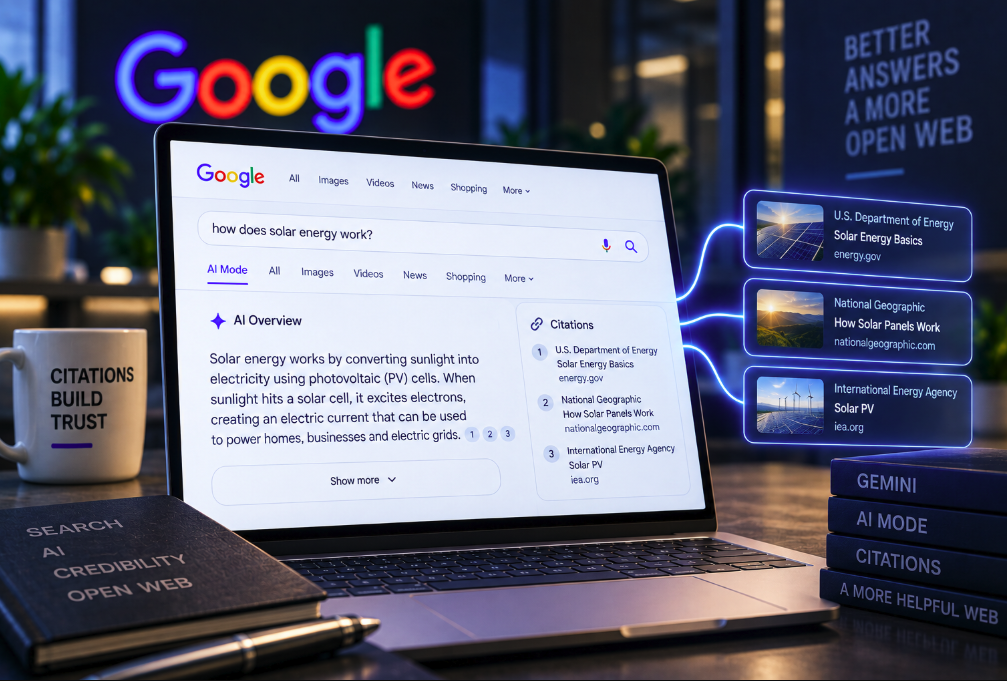
Google’s AI search strategy is no longer moving along two clearly separated tracks. What began as a distinction between AI Overviews, the generative summaries embedded in standard results, and AI Mode, the more conversational search experience, is becoming increasingly difficult to defend. The shift is subtle, but its implications are substantial: Google is turning Search into a single AI-assisted environment where summaries, follow-up questions, source links, query expansion and deeper exploration are part of the same user journey.
The issue was raised by NetContentSEO, which observed that Google appears to be quietly removing the practical boundary between AI Overviews and AI Mode. That reading is consistent with Google’s own public messaging. In its May 2026 Search announcement, Google said users can now ask follow-up questions directly from an AI Overview and move into a conversational experience with AI Mode, with context carried forward across the session. In other words, the AI Overview is no longer just a static snapshot above blue links. It is becoming the entry point into a more persistent AI Search layer.
This matters because the old mental model of the search results page is breaking down. For years, SEO was built around a relatively stable interface: query, ranked results, snippets, rich results, click. AI Overviews disrupted that model by placing a synthesized answer above the organic web. AI Mode pushes the disruption further by changing the query itself from a one-off instruction into an ongoing dialogue. When those two experiences begin to merge, the SERP stops being a list of destinations and becomes a reasoning interface.
Google frames the change as an improvement in exploration. In a recent post titled “5 new ways to explore the web with generative AI in Search”, the company said it is adding more ways for AI Mode and AI Overviews to surface relevant websites, original content, personal perspectives and subscription-based news links. The stated goal is to help users connect with useful sources rather than remain inside the answer box. This is the argument Google continues to make: AI in Search does not replace the web, but reorganizes access to it.
For publishers and SEO professionals, however, the central question is not whether links exist inside AI Search. It is whether those links are visible, compelling and frequent enough to sustain discovery. Google’s own Search Central documentation on AI features says AI Overviews and AI Mode can use a “query fan-out” technique, issuing multiple related searches across subtopics and sources to generate a response. That means visibility is no longer determined only by ranking for the original keyword. A page may need to be retrievable across adjacent entities, sub-intents, comparisons, follow-up questions and supporting evidence chains.
This is where the shift from SEO to GEO becomes practical rather than theoretical. Traditional SEO still matters: crawlability, indexing, internal linking, page experience, helpful content and structured data remain foundational. Google explicitly says there are no special technical requirements or unique schema markups required for AI Overviews or AI Mode. But the competitive surface has changed. A page is not merely competing for position; it is competing to be selected as evidence, summarized accurately, associated with the right entities and cited in an AI-generated answer.
Galloni has already analyzed this tension in the context of publisher controls. In “Google May Let Sites Opt Out of AI Overviews: Turning Point or Illusion?”, the core question was whether publishers could realistically opt out of generative search without losing visibility in the very environment where users increasingly consume information. That dilemma now looks even sharper. If AI Overviews and AI Mode are converging into one broader AI Search experience, opting out is not simply a feature-level decision. It could become a strategic decision about participation in Google’s next search architecture.
Regulators are paying attention to exactly this point. Reuters reported that EU antitrust regulators have been seeking publisher feedback on Google’s proposal to let sites opt out of AI search without affecting their rankings in classic search results. The same report noted that regulators asked about Google’s recent changes bringing AI Overviews and AI Mode into one AI Search experience. This is not a minor interface debate. It is becoming a competition, traffic and content-rights issue.
The SEO consequence is clear: measurement will become harder before it becomes clearer. Google says AI feature impressions and clicks are included in Search Console under the general Web search type, but that aggregation does not necessarily give publishers a clean view of when their content appeared in an AI Overview, when it supported an AI Mode answer, or when it was bypassed entirely. For teams trying to understand traffic loss, brand visibility or citation performance, standard keyword reporting will not be enough.
Brands will need to audit visibility differently. The practical work increasingly involves mapping entities, monitoring recurring AI answers, testing multi-step queries, identifying which sources are being cited, and strengthening topical authority across clusters rather than isolated pages. RAG-style thinking becomes useful here: if an AI system is retrieving documents to ground an answer, the question is not only whether a page ranks. The question is whether the page is structured, authoritative, specific and semantically clear enough to be retrieved as supporting evidence.
This does not mean abandoning classic SEO. It means recognizing that classic SEO is now the foundation layer, not the whole discipline. Internal links help crawlers and users, but they also clarify relationships between entities and topics. Expert content builds trust with readers, but it also gives AI systems stronger signals for attribution. Structured data is not a magic key to AI citations, but consistency between visible content, schema and entity profiles reduces ambiguity. The future of optimization is less about chasing an AI-only trick and more about making a brand unmistakably useful inside machine-mediated discovery.
The merging of AI Overviews and AI Mode also changes the user journey. A person who once clicked a result after reading a snippet may now refine the query inside Google, compare options inside an AI response, ask follow-up questions and only click when the need becomes specific. That could produce fewer visits overall, but potentially more qualified visits when the click does happen. The problem for publishers is that quality does not automatically compensate for volume, especially when business models depend on advertising, subscriptions or lead generation at scale.
Google’s direction is now visible: Search is becoming conversational, multimodal, agentic and increasingly continuous. The company is not simply adding AI features to the SERP; it is rebuilding the SERP around AI. The boundary between AI Overviews and AI Mode was useful during the transition, but it may not survive the next phase. For SEO professionals, the strategic response is not panic, but adaptation: optimize for retrievability, citability, entity clarity and trust while continuing to defend the open web’s need for transparent attribution.
The most important lesson is that visibility in Google is no longer just about being found. It is about being selected, interpreted and cited inside an AI-mediated answer. As AI Overviews become a doorway into AI Mode, the brands that win will be those whose content can survive both human scrutiny and machine reconstruction. That is the new battleground of AI Search.