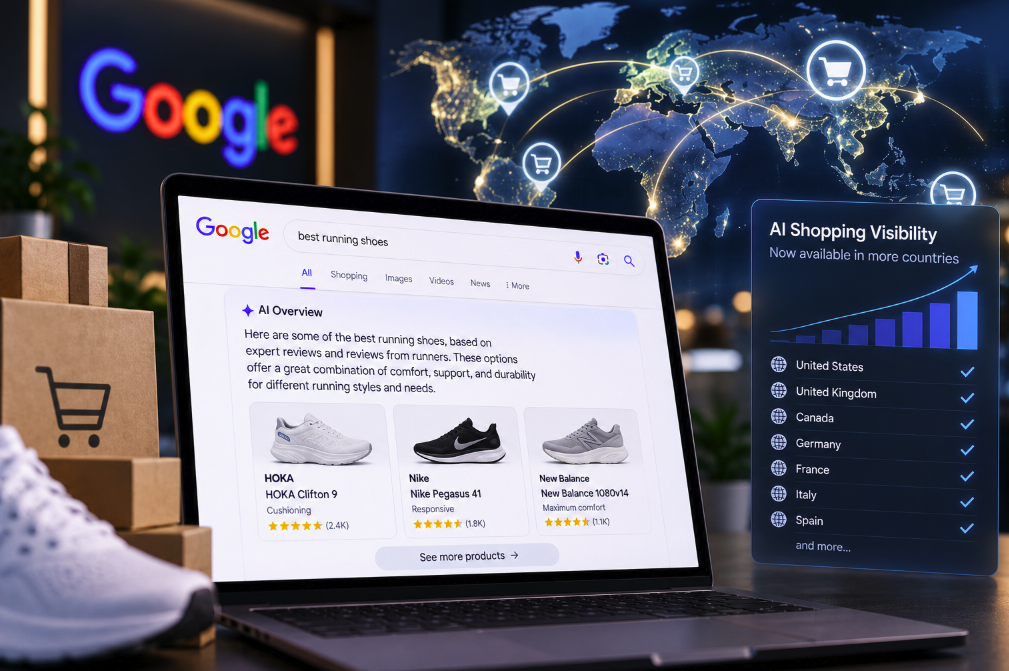
Retailers trying to understand whether their products appear inside Google's generative shopping experiences now have access to a broader measurement layer. Google Merchant Center's AI Performance Insights are currently available for eligible accounts in Australia, Canada, India, New Zealand and the United States, extending a reporting capability that turns AI-driven product discovery into something merchants can begin to measure rather than infer from scattered traffic signals.
The expansion was highlighted in a NetContentSEO analysis published on September 3. More importantly, Google's current Merchant Center documentation confirms the five-country availability and specifies that the report currently covers English-language queries. The geographic expansion is still limited compared with Merchant Center's global footprint, but strategically it matters because Google is formalizing a new analytics category: visibility inside conversational shopping journeys.
Google is turning AI shopping visibility into a measurable channel
Generative search creates a difficult attribution problem for ecommerce teams. In conventional search, marketers can monitor impressions, positions, clicks, product views and conversions through relatively mature reporting systems. In an AI-mediated journey, a shopper can describe a need conversationally, evaluate alternatives and encounter several products inside a generated response without following the familiar sequence of keyword query, results page and website visit.
Google says AI Performance Insights are intended to help merchants understand how brands appear for conversational queries with shopping intent across AI Mode and AI Overviews. The report sits in Merchant Center under Analytics, Products and the AI performance tab. Google's original May 2026 announcement described the broader initiative as a way to understand product discovery across AI-powered experiences, including Search and Gemini.
This is an important shift in measurement philosophy. The question is no longer only whether a product generated a click. Retailers can start asking whether their brand entered the AI system's visible consideration set at all.
Share of voice becomes a commerce metric for AI Search
One of the central metrics in the report is share of voice. Google calculates a merchant's share from the number of AI impressions captured by its brand or products relative to the total impressions generated by the merchant and its defined competitor set for related queries. The report also shows the average share captured by those competitors, allowing retailers to compare their visibility against the market Google associates with the account.
That creates a useful measurement layer above clicks and sessions. A product can fail to generate traffic because demand is weak, because it was shown but ignored, or because it never surfaced in the AI experience. Share of voice helps merchants begin separating those scenarios by measuring exposure before the visit.
Google also reports frequency, which represents the relative popularity of search types, terms, intents or product attributes, and “products showing,” which indicates how many products from the merchant appear for selected dimensions. Used together, these metrics can expose a particularly actionable mismatch: consumers may frequently express an attribute or intent while the retailer has few products appearing for it.
Google maps conversational shopping into three stages
AI Performance Insights does not treat every commercial conversation as equivalent. Google groups shopping activity into three stages: discovery, evaluation and ready to buy. Discovery covers early exploration, evaluation captures comparisons and deeper product research, and ready-to-buy behavior reflects stronger transactional intent.
This funnel is well suited to conversational search because one dialogue can move through several stages without requiring separate queries or sessions. A shopper might begin by asking what type of running shoe suits a particular training goal, then compare cushioning and materials, and finally ask where to buy a selected model. Traditional keyword reporting can fragment that journey into unrelated searches. An AI-native report can instead analyze the underlying shopping intent.
For ecommerce teams, stage-level share of voice can reveal where a brand disappears. A retailer might be visible during broad discovery but lose representation when users compare specifications. Another may appear mainly near purchase because its product data is strong for exact models but weak for exploratory category language. Those patterns create different optimization priorities.
Product terms and attributes become GEO inputs
The report also exposes popular product terms, search intents and attributes. Google's examples include characteristics such as color, style and material, alongside contextual language used in shopping conversations. This is particularly valuable because generative search allows users to express requirements in much richer language than the compressed keywords that shaped traditional search marketing.
Google explicitly recommends using these insights to improve Merchant Center product data. That includes maintaining accurate and current catalog information, incorporating relevant high-priority terminology into titles and descriptions where appropriate, and filling missing structured attributes identified through the report.
This pushes product-feed management and Generative Engine Optimization closer together. Titles, descriptions, categories, materials, colors, sizes, availability and other structured attributes are not merely operational fields for Shopping. They are machine-readable evidence that helps a retrieval system determine whether a product satisfies a nuanced request.
If a consumer asks for a lightweight waterproof jacket made from a particular material and a merchant has failed to describe those characteristics accurately, the AI system has less evidence that the product belongs in the answer. Better product data does not guarantee selection, but incomplete data can constrain the system's ability to match complex intent.
The report measures organic AI visibility, not the whole market
The new metrics need careful interpretation. Google's documentation says the current report is limited to organic AI traffic, such as free listings. Paid advertising traffic is not included. This means AI Performance Insights should not be treated as a complete accounting of a retailer's exposure across every commercial Google surface.
The competitive data also has boundaries. Merchants do not manually choose the competitor set available in the report; Google defines it. In cases where sufficient competitor data is unavailable, a merchant can appear to have 100% share of voice without that percentage meaning it dominates the broader category. Zero values and missing values can also represent different data conditions.
These caveats matter because new AI metrics are easy to overstate. A rising share of voice indicates that a brand is appearing more frequently relative to the available comparison set. It does not automatically demonstrate stronger revenue, market share or customer preference. The metric should be analyzed alongside conventional product performance, demand, conversions and profitability.
AI visibility reporting is becoming part of Google's analytics stack
The Merchant Center expansion is not happening in isolation. Google has also introduced dedicated generative-AI visibility reporting in Search Console. In its Search Central announcement, Google said the reports provide separate views of impressions within generative AI features such as AI Overviews, AI Mode and generative experiences in Discover. As of August 31, Google says those Search Console insights have rolled out to websites worldwide.
Together, the two reporting initiatives show Google separating AI visibility into meaningful contexts. Search Console helps publishers understand how websites appear in generative search features, while Merchant Center gives retailers commerce-specific metrics around brands, products, attributes and shopping stages. AI visibility is becoming a first-class analytics object rather than an opaque side effect of ordinary search reporting.
Conversational commerce changes what ecommerce SEO needs to measure
For years, ecommerce search teams have optimized around rankings, Shopping visibility, impressions, clicks and conversion rates. Conversational commerce introduces an earlier question: when the system interprets a shopper's detailed request, does the product enter the answer at all?
That is fundamentally a selection problem. A product may be indexed, technically eligible and commercially competitive yet fail to appear because the system lacks sufficient evidence that it matches the requested use case. Conversely, complete structured data and clear product descriptions can make it easier for AI systems to understand attributes that matter to the shopper.
This is where GEO becomes practical rather than theoretical. Ecommerce GEO is not about inserting artificial “AI keywords” into product pages. It is about reducing ambiguity between what consumers ask for and what machines can reliably understand about a catalog. Merchant Center's new reporting provides a feedback loop: observe conversational demand, measure visibility, identify missing product evidence, improve the feed and then monitor whether visibility changes.
International expansion is modest, but the direction is clear
Australia, Canada, India and New Zealand represent a relatively small expansion compared with the number of countries where Google supports ecommerce products and Merchant Center functionality. Availability is also currently restricted to English-language queries. Retailers in many major European markets therefore do not yet have the same Merchant Center AI Performance Insights access described in Google's current documentation.
Even so, the strategic signal is significant. Google is building measurement infrastructure around shopping journeys that start or develop inside generative AI. Once a platform creates standardized metrics such as AI share of voice, shopping-stage visibility and products showing, those metrics can begin entering routine ecommerce reporting, agency dashboards and optimization workflows.
AI shopping is therefore moving out of the experimental measurement phase. Merchants no longer have to rely exclusively on manual prompts or anecdotal screenshots to determine whether Google is surfacing their products in conversational search. The data remains partial and needs careful interpretation, but it creates something ecommerce teams have been missing: a platform-level view of how product visibility behaves before the click.
That may be the most important consequence of Google's international expansion. AI Search is not merely changing the interface through which people shop. It is creating a new competitive layer that retailers can now start to quantify. When visibility becomes measurable, optimization follows — and AI shopping performance begins to look less like an experimental curiosity and more like a permanent part of search marketing.