Google has fixed the citation problem that briefly made Gemini 3.8 Flash in AI Mode look dramatically less connected to the open web. The issue appeared almost immediately after the new model reached Google's search experience: informational answers that normally included source links were returning with few or no visible citations. Within roughly a day of the public escalation, Google acknowledged that the behavior was unintended and fresh tests showed links returning.
The sequence is documented in a September 4 NetContentSEO follow-up and in Search Engine Roundtable's evolving report on the rollout. The resolution changes the interpretation of the original screenshots. They were evidence of a product defect during a model transition, not evidence that Google had deliberately decided to strip attribution from Gemini 3.8 Flash answers.
For publishers and GEO teams, however, the episode remains important. It demonstrates how quickly a model-level product change can alter visible citations without anything changing on the publisher's website. In AI Search, an apparent visibility collapse can originate inside the answer engine itself.
Gemini 3.8 Flash reached AI Mode and the links almost disappeared
Google introduced Gemini 3.8 Flash on September 2, describing it as its most intelligent Flash model and positioning it for software engineering, agentic workflows and complex multi-step reasoning. Google's official launch announcement says the model maintains the speed and introductory pricing of 3.7 Flash while improving reasoning and agentic performance.
Google also brought the model into Search's AI Mode for eligible subscribers. Soon afterward, search observers including Gagan Ghotra and Glenn Gabe began sharing examples in which Gemini 3.8 Flash produced substantial answers with almost no source links. Gabe compared the new model with the default AI Mode experience and observed a visible difference in citation behavior.
The examples were especially notable for broad, top-of-funnel informational questions. Those are precisely the queries where an AI answer can satisfy a user's immediate need without requiring a visit to another website, making source attribution particularly important to publishers.
Google explicitly said the behavior was not intended
The strongest evidence about Google's intent came from Robby Stein, vice president of product for Google Search. Responding publicly to the reports, Stein said the experience was not working as intended and that Google would roll out a fix.
That statement matters because it separates an implementation failure from a product-policy change. Without Google's response, the screenshots could reasonably have prompted speculation that Gemini 3.8 Flash had introduced a new citation strategy. Once Google identified the behavior as incorrect, the more defensible explanation became a rollout bug.
Search Engine Roundtable subsequently updated its report after Gabe retested the model and found that links were appearing again. The current state is therefore different from the initial September 3 observations: the abnormal near-total disappearance of citations has been repaired.
The fix does not mean every answer will have the same citations
It would be equally misleading to move from “citations were broken” to “citation behavior is now identical across every Google model.” Generative answers vary with the query, retrieved evidence, model, interface and response construction. The fact that links have returned does not establish a fixed citation count or guarantee that Gemini 3.8 Flash will cite exactly the same sources as the default model.
No controlled public benchmark accompanied the initial reports. The evidence consisted of multiple observed examples and side-by-side tests, strong enough to reveal an obvious anomaly and strong enough for Google to confirm a defect, but not sufficient to calculate a universal before-and-after citation rate.
This distinction is essential for serious AI Search measurement. Screenshots can establish that a behavior occurred. They cannot automatically establish its frequency across thousands of queries.
The incident exposes a new source of SEO volatility
Traditional SEO teams are accustomed to diagnosing traffic changes through ranking movements, indexing problems, algorithm updates, SERP features and seasonality. AI Search introduces another layer: the answer engine's citation system can change independently of the publisher.
A site can remain crawlable, indexed and authoritative while its visible citations fall because an AI product has changed models, retrieval behavior or interface logic. A temporary defect can therefore look like a content problem. Teams that react immediately by rewriting pages may be optimizing against an incident occurring entirely on Google's side.
The Gemini 3.8 Flash episode is an unusually clean example because the anomaly appeared around a model rollout, was publicly identified, was acknowledged by Google and was quickly reversed. Future cases may be harder to diagnose.
AI visibility monitoring needs model-level granularity
Measuring “Google AI Mode visibility” as a single metric is becoming less adequate as the product supports different models and modes. If users can receive answers from different model configurations, a site's citation frequency may depend partly on which configuration produced the answer.
Monitoring systems should therefore record as much execution context as the interface makes observable: the prompt, date and time, geography, model or mode, whether web retrieval was active, the brands mentioned, the domains cited and the structure of the response. Repeated runs are preferable to isolated screenshots because generative outputs can vary even without a product update.
This is the same broader measurement problem confronting GEO across the industry. AI Search is not one deterministic ranking table. It is a collection of changing systems that retrieve, synthesize and attribute information differently.
Citation presence and referral traffic are separate metrics
Restoring citations is good news for publishers, but it does not resolve the economics of generative search. A visible link gives a user a path to the source. It does not guarantee that the user will take it.
Traditional search results make the external destination the central object of the interface. The user sees a result and normally clicks it to consume the information. AI Mode can provide the information first and attach sources as supporting evidence. A user may read the generated answer, accept it and never visit any cited page.
Publishers should therefore separate at least two questions. The first is attribution: does the AI system cite the site? The second is referral value: when the site is cited, does that citation generate meaningful visits, conversions or brand discovery?
The Gemini bug temporarily damaged the first layer. Google's fix restores the possibility of attribution, but it does not tell us how much traffic those citations will generate.
Citations also perform a trust function
Links are not valuable only because they can send traffic. They also let users inspect where a generated claim came from. That is particularly important for topics where freshness, expertise or evidence quality matters.
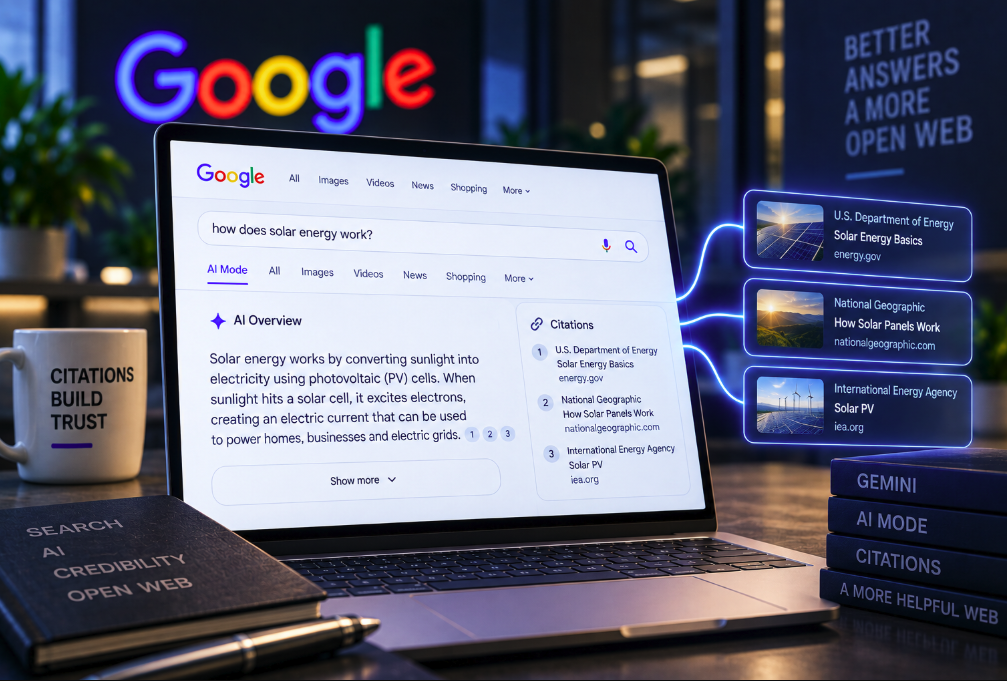
Without visible sources, a long AI answer can appear authoritative while giving the reader little practical way to verify its foundation. Citations create a bridge between generated synthesis and the documents used to support it. They allow users to move from an answer to primary research, official documentation, reporting or specialist analysis.
Google's response to the bug is therefore meaningful beyond publisher economics. By saying the link-free behavior was not intended, the company indicated that source connections remain part of the expected AI Mode experience, at least in this case.
Google's own model documentation reinforces the role of grounding
Gemini 3.8 Flash is not technically incapable of working with search sources. Google's developer documentation for the model lists Search grounding among its supported capabilities, alongside function calling, file search, URL context and other tools.
The missing links in AI Mode should therefore not be interpreted as a fundamental limitation of the underlying model. Consumer Search is a larger product stack in which model inference, retrieval, grounding, citation generation and interface presentation interact. A failure in one layer can change what the user sees even when other layers continue functioning.
For SEO practitioners, that architecture matters. “The model did not cite us” may be an imprecise diagnosis. The relevant failure could involve retrieval, source selection, attribution logic or presentation rather than the model's core knowledge.
A one-day bug can contaminate a long-term benchmark
The speed of this incident also creates a methodological warning for AI visibility studies. Imagine a monitoring platform running half of a monthly query panel while citations were broken and the other half after Google's fix. The aggregate result could show an apparent decline in publisher visibility that never represented a stable product state.
Without model and timestamp metadata, researchers might attribute the change to content quality, authority or a new AI Search ranking factor. In reality, they would be measuring two versions of the product.
This is why reproducibility is becoming central to GEO research. Researchers should document when tests ran, which model or interface was used, how prompts were phrased and whether the behavior can still be reproduced. AI Search changes too quickly for undated screenshots to function as durable evidence.
Publishers should distinguish anomalies from trends
When citations suddenly disappear, the first response should be verification rather than panic. Teams can rerun a stable prompt set, compare multiple models or modes where possible, check whether competitors have also disappeared and look for reports from other independent observers.
If the loss affects many unrelated publishers simultaneously, a platform-side change becomes more plausible. If only one site loses visibility while competitors remain stable, publisher-specific factors deserve more attention. Neither pattern proves causality, but the comparison narrows the investigation.
The same discipline applies when visibility suddenly improves. One favorable AI answer should not be treated as a new baseline until it persists across repeated tests.
The broader citation debate remains unresolved
Google fixing this defect does not answer the larger question of how generative search will distribute value between answer engines and the web sources they use. Publishers still need to understand how frequently they are cited, how prominently citations are displayed and whether those placements generate visits.
AI products will continue experimenting with layouts, source panels, inline links and generated summaries. A design can technically contain citations while making them less central than traditional organic results. Conversely, a well-placed source link can introduce a publisher to users who might never have encountered it through a conventional blue-link query.
The right metric is therefore not simply whether citations exist. It is how attribution behaves across the entire discovery journey.
The lesson is bigger than one Gemini bug
The Gemini 3.8 Flash incident began as a worrying observation: Google's newest AI Mode option appeared to generate answers while almost eliminating visible sources. It ended quickly. Google said the behavior was unintended, deployed a fix and links returned.
For publishers, that resolution is reassuring, but the temporary failure exposed a structural reality of AI Search. Visibility now depends not only on what a website publishes and how search systems retrieve it, but also on rapidly changing model and interface layers that publishers do not control.
That makes GEO measurement a versioned discipline. A citation result needs a prompt, a model, a date and repeated observations before it becomes a meaningful benchmark. When those variables are recorded, teams can distinguish a real visibility trend from a temporary product defect. Gemini 3.8 Flash's links are back; the need for more rigorous AI Search monitoring is not going away.