Technical SEO teams have always looked for legitimate ways to help Google discover important changes faster. That makes sitemap cache busting superficially attractive: append a timestamp or version parameter to a sitemap URL, change it regularly, and perhaps Google will treat the file as new and fetch it more aggressively. The problem is that this applies a front-end caching technique to a resource whose value depends partly on having a persistent identity.
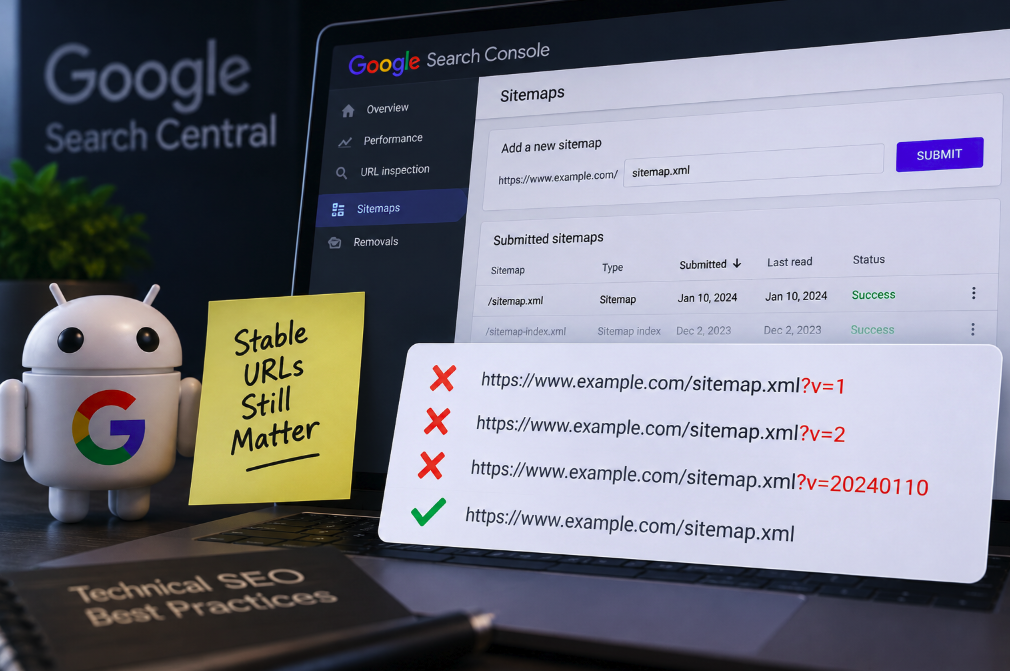
A new NetContentSEO analysis examines recent guidance from Google's John Mueller on exactly this practice. The scenario involved child sitemap URLs whose query-string timestamp changed daily. Mueller's objection is straightforward: repeatedly changing the address effectively presents the same conceptual sitemap under a succession of different URLs. For search infrastructure and technical monitoring, stability is generally more useful than manufactured novelty.
Cache busting solves the wrong problem
Cache busting is a legitimate engineering pattern when a browser or intermediary cache must retrieve a new version of a static resource. A stylesheet might move from styles.css?v=41 to styles.css?v=42 after deployment so that clients do not continue using stale CSS. The changing URL is intentional because the developer wants the resource to be treated as a new cache object.
A sitemap serves a different purpose. It communicates discoverable URLs and modification information to search engines. If a sitemap index points to sitemap-products.xml?t=1720000000 today and a different timestamped URL tomorrow, the publisher may think of those files as one logical resource, but a crawler receives different addresses. The tactic introduces URL churn without proving that any underlying page has actually changed.
That distinction matters because crawling is not improved merely by making a file look new. Google still decides what to crawl, how frequently to revisit URLs and how to allocate resources across a site. A changing sitemap URL cannot force Googlebot to crawl every page listed inside it on the publisher's preferred schedule.
Google already provides a sitemap-level change signal
There is no need to encode freshness into the sitemap URL because the protocol already has a field for that job. Google's sitemap index documentation supports the optional
The cleaner architecture is therefore intentionally uneventful: keep a stable sitemap index, keep stable child sitemap URLs and update the relevant lastmod value when a child sitemap genuinely changes. The resource keeps the same identity while its metadata communicates a meaningful modification.
The same principle applies inside ordinary XML sitemaps. Google's sitemap guidance says page-level lastmod should represent the last significant modification to the page rather than a cosmetic or automated date refresh. Primary content changes can qualify; simply rewriting the date every day does not create meaningful freshness.
Accurate freshness is more useful than synthetic freshness
This is the deeper technical SEO lesson. Search engines need signals that compress reality efficiently. A reliable lastmod tells a crawler that something worth reconsidering has changed. A timestamp that updates regardless of the underlying content tells the crawler almost nothing.
At scale, signal quality matters. If an ecommerce site has millions of product URLs, it is useful to know which sitemap segments actually changed after inventory updates. If every sitemap is given a new URL every day, the system creates activity without necessarily adding information. Monitoring also becomes harder because fetch history, response behavior and errors are distributed across many parameterized variants.
Stable URLs make operational analysis easier. Server logs can show how often Googlebot requests the same sitemap resource. Search Console can report its processing state. Monitoring systems can follow one endpoint over time. When the address changes continuously, teams have to normalize those variants before they can even answer basic questions about fetch frequency and failures.
A sitemap is a discovery hint, not a crawling command
The urge to cache-bust sitemap files often comes from a mistaken model of how crawling works. Submitting or modifying a sitemap does not instruct Googlebot to immediately crawl every URL inside it. Sitemaps help discovery and can provide useful metadata, but Google's crawler still makes its own scheduling decisions.
Google's crawl guidance emphasizes the wider system around discovery: internal linking, server responsiveness, URL importance, change patterns and the site's ability to handle crawling all matter. Its crawl-budget documentation recommends keeping sitemaps current and using accurate lastmod information for updated content. It also recommends efficient page delivery and HTTP caching mechanisms such as 304 Not Modified responses, which can reduce unnecessary bandwidth and server work.
This is almost the opposite of the cache-busting mindset. Good crawl engineering does not try to make every resource appear permanently new. It helps crawlers distinguish changed resources from unchanged ones efficiently.
Google has already moved away from forced sitemap refresh mechanisms
The current advice also fits Google's longer-term direction. In 2023, Google deprecated the unauthenticated sitemap ping endpoint. At the time, the company said its internal studies found that sitemap ping submissions were not very useful and that most led to spam. Google pointed publishers instead toward normal sitemap discovery through Search Console and robots.txt, together with accurate lastmod values.
The common thread is information quality. Repeated pings do not tell Google what changed. Rotating timestamp parameters do not tell Google what changed. A trustworthy modification date, clean internal architecture and accessible canonical pages do.
That does not mean sitemaps are unimportant. For large publishers, ecommerce platforms, marketplaces and sites with URLs that are difficult to discover through navigation alone, well-designed sitemap architecture can be critical. The point is that its value comes from accurate discovery data, not from artificially increasing the number of sitemap URLs Google encounters.
What technical SEO teams should do instead
If Google is discovering or recrawling important pages too slowly, the first task is diagnosis. Confirm that the sitemap contains the canonical URLs the site actually wants indexed. Check whether important pages are strongly linked internally. Review server logs to see whether Googlebot is fetching the sitemap and target pages. Look for slow responses, server errors, redirect chains and unnecessary URL duplication that may be consuming crawl resources.
Large sites can divide inventories into logical sitemap groups so that changes are easier to communicate and monitor. Product, category, editorial and other URL classes can be separated when doing so helps operations. The child sitemap addresses can remain stable while their modification metadata changes when necessary.
For highly time-sensitive publishing, specialized discovery mechanisms can also be appropriate. News publishers can use news sitemaps, and feeds can help expose recent content. Search Console offers URL inspection and recrawl-request functionality for individual cases. None of these mechanisms, however, turns crawling into an on-demand API where a publisher can guarantee that Google will revisit every page immediately.
Stable URLs are part of good search infrastructure
The broader principle extends beyond sitemap files. Google's documentation repeatedly favors clear, consistent URL identities. Its canonicalization systems cluster duplicate and near-duplicate URLs, and the presence of a URL in a sitemap is one of the signals Google can use when selecting a canonical. Introducing avoidable URL variants creates additional states that systems, logs and humans have to reconcile.
Technical SEO often improves when infrastructure becomes less clever. A persistent sitemap URL is easy to reference from robots.txt, easy to submit in Search Console, easy to monitor and easy to troubleshoot. Accurate lastmod metadata communicates actual changes without changing that identity. Clean canonical URLs give crawlers consistent destinations.
The practical rule is simple: do not use cache-busting parameters as a substitute for meaningful crawl signals. If a sitemap changes, update its contents and modification metadata. If pages change, report those changes accurately. If crawling is slow, investigate discovery, server performance, internal architecture and crawl demand. Making sitemap.xml look like a different resource every day does not create fresher content; it only creates another URL.
Google's latest clarification is therefore less a new rule than a reminder of a durable SEO principle. Search infrastructure works best when URLs have stable identities and metadata tells the truth about what changed. In sitemap engineering, boring consistency is not a limitation. It is a feature.