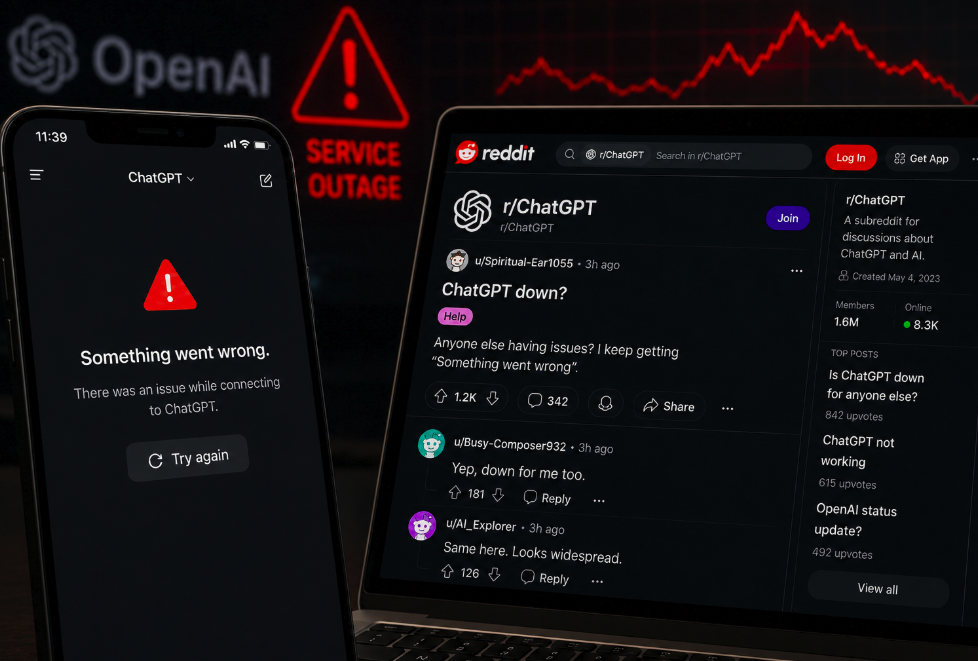
ChatGPT users are reporting service problems on Monday, August 31, 2026, and this time there is an official incident behind at least part of the disruption. OpenAI's status page currently lists a partial outage affecting ChatGPT Work, with users across multiple subscription plans potentially unable to start or continue tasks. The company says it has identified elevated errors and latency and is working on a mitigation.
The disruption surfaced quickly in user discussions, including a new r/ChatGPT thread asking whether ChatGPT is down. Community reports are useful as an early warning signal, but they do not by themselves establish the scope of an outage. In this case, however, OpenAI's official incident page confirms an active problem with ChatGPT Work.
What OpenAI has confirmed
OpenAI describes the incident as elevated errors and latency affecting ChatGPT Work. Its status page says users across multiple subscription plans may be unable to start or continue tasks and that a mitigation is being implemented. The company's availability figures are aggregated across tiers, models and error types, so an individual user's experience can differ depending on the plan and feature being used.
Same-day reporting also points to a meaningful spike in complaints. BleepingComputer reported that the disruption began at approximately 11:04 a.m. Eastern Time and that Plus subscribers appeared particularly affected because Work mode was unavailable for some users. Other outage reporting cited more than 2,000 user problem reports on Downdetector around 9:01 a.m. Pacific Time.
The available evidence therefore supports a narrower conclusion than the phrase “ChatGPT is down” might imply. OpenAI is not currently describing a total global failure of every ChatGPT function. It is reporting a partial outage centered on ChatGPT Work, while users may experience different levels of impact elsewhere in the product.
Why Reddit often detects outages before the full picture is clear
When a widely used cloud service begins failing, Reddit and other social platforms frequently become informal monitoring systems. Users compare error messages, locations, devices and subscription plans, often producing a recognizable pattern before an official status page has been updated. For ChatGPT in particular, a sudden cluster of “is it down?” posts can reveal that what looks like an isolated browser or account problem is affecting many people at once.
Those reports still need verification. A user can encounter an error because of a local connection, authentication issue, browser extension, account-specific problem or overloaded feature without the entire platform being unavailable. The most reliable approach is therefore to combine community signals with the provider's status page and independent outage monitoring rather than treating a viral thread as definitive evidence.
ChatGPT's growing role makes partial outages more consequential
The significance of a ChatGPT outage has changed as the product has expanded beyond a simple conversational interface. Users now depend on AI systems for research, coding, writing, document analysis and multi-step work. ChatGPT Work in particular is designed for longer-running tasks, which means a failure can interrupt workflows rather than merely delay a single answer.
This creates a reliability challenge familiar from other forms of digital infrastructure. As AI assistants become embedded in daily professional processes, availability becomes part of product quality. Latency, failed task execution and interrupted sessions can have real operational costs for teams that have built AI into routine research, marketing, software development or administrative work.
The timing is also notable because ChatGPT's role as an information-discovery service is becoming increasingly formal. Galloni.net recently covered the European Union's designation of ChatGPT as a Very Large Online Search Engine. That regulatory milestone reflects the service's scale and influence; outages are the other side of the same story. The more people rely on an AI system as a gateway to information and work, the more visible even a partial disruption becomes.
This is not ChatGPT's first recent service incident
OpenAI's status history shows several ChatGPT-related incidents during August. On August 27, Workspace Agents and ChatGPT Work experienced increased error rates on web and mobile before recovering. Earlier in the month, the company recorded conversation errors affecting different subscription tiers, login problems and other periods of degraded availability.
That does not necessarily indicate a single recurring technical cause. Large cloud products can fail for many unrelated reasons, and OpenAI has not publicly attributed the current incident to the same issue behind earlier disruptions. It does, however, illustrate the complexity of operating an AI platform whose functionality now spans conversations, models, tools, agents, file handling, image generation and long-running tasks.
What users should do during the outage
Users experiencing errors should first check OpenAI's status page before repeatedly changing account settings or troubleshooting their devices. If the incident matches the feature that is failing, local fixes may have little effect until the provider deploys a mitigation. Work that can be performed outside the affected mode may still be available because a partial outage does not necessarily disable the entire ChatGPT service.
For organizations that depend heavily on AI workflows, the broader lesson is resilience. Important prompts, source material and work products should not exist only inside a single live AI session. Teams should preserve critical inputs and outputs in their own systems, maintain conventional alternatives for essential tasks and design processes that can tolerate temporary service interruptions.
The outage is ongoing, so the status can change quickly
At the time of writing, OpenAI says it has identified the problem and is working on mitigation. There is not yet an official resolution notice on the active incident page. Because outage conditions can change within minutes, the company's status page remains the authoritative source for whether the affected ChatGPT Work functionality has recovered.
The Reddit discussion is nevertheless a useful reminder of how users experience AI infrastructure: not as an abstract uptime percentage, but as a tool that suddenly stops completing the task in front of them. As ChatGPT becomes a larger part of search, research and professional workflows, service reliability will increasingly matter alongside model intelligence. An AI assistant can be extraordinarily capable, but for users who depend on it, availability is part of capability too.