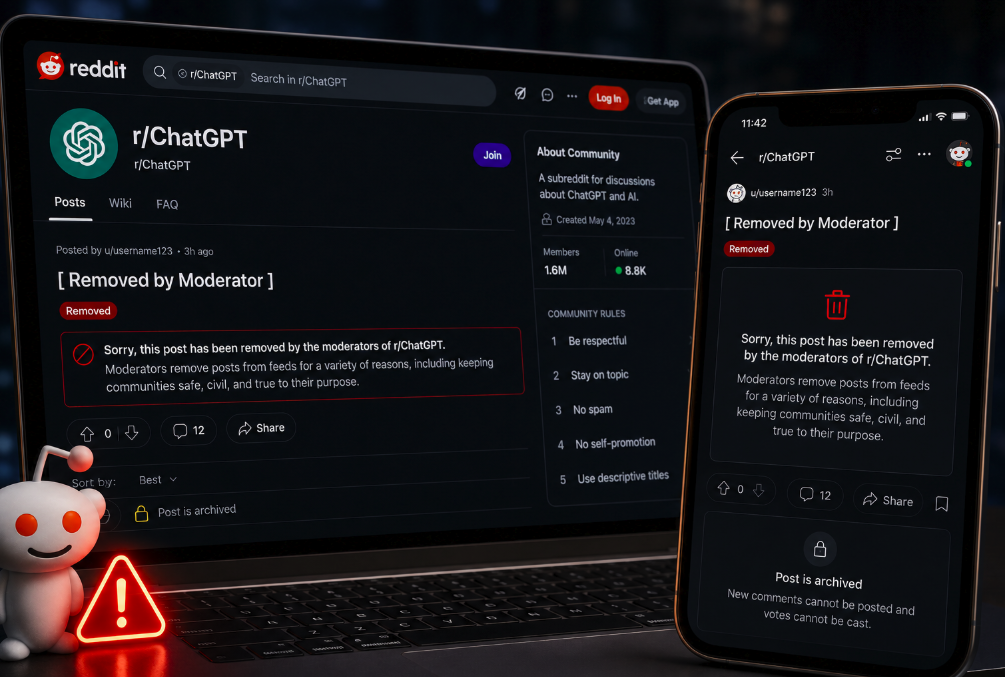
A freshly removed post in r/ChatGPT offers an unusually compact snapshot of a much larger tension around AI products: users form strong expectations around model behavior, while platforms and communities need mechanisms for handling the recurring wave of complaints that follows model changes. The original post itself is no longer visible, so its specific claims cannot responsibly be reconstructed. What remains visible, however, is the moderator explanation — and that explanation is revealing.
On the Reddit thread supplied as the source, the r/ChatGPT moderation team says the post was removed because complaints about GPT-4o/GPT-5 changes, including claims that models have been made “dumber,” belong in the community's dedicated complaints megathread. The notice also says the action was automated by GPT-5. That does not tell us what the deleted author argued, but it does establish the category into which moderators placed the post.
The missing post matters less than the moderation category
Deleted social-media content creates a basic reporting problem. Once the body of a post is unavailable, screenshots, summaries and assumptions can quickly turn into an invented reconstruction. The defensible approach is to report only what remains verifiable. In this case, Reddit shows that the post was published in r/ChatGPT on September 1, 2026 and subsequently removed by moderators, while the moderation notice explicitly classifies it as part of the recurring debate over perceived changes in model quality.
That classification is not an isolated moderation rule created for one user. r/ChatGPT maintains a dedicated GPT-4o/GPT-5 complaints megathread, and other removed posts have received similar instructions to move discussions about model regressions, availability and behavioral changes there. The existence of a containment thread indicates that these complaints have been frequent enough for moderators to separate them from the main flow of the subreddit.
Why model changes produce unusually strong reactions
AI models are not experienced like conventional software features. A user can build a workflow around the tone, creativity, reasoning style, formatting habits or conversational behavior of a particular model. When that behavior changes, even if aggregate benchmarks improve, the user may experience the update as a loss rather than an upgrade.
OpenAI itself has acknowledged this phenomenon. In its January 2026 explanation of GPT-4o's retirement, the company said it had previously restored access after hearing from Plus and Pro users who needed more time to transition important use cases and who preferred GPT-4o's conversational style and warmth. OpenAI said that feedback influenced later models, including improvements to personality, creative ideation and customization.
The company ultimately retired GPT-4o from ChatGPT on February 13, 2026, alongside GPT-4.1, GPT-4.1 mini, o4-mini and the earlier GPT-5 Instant and Thinking models. OpenAI's current help documentation says conversations using deprecated models were moved to newer equivalents. That migration illustrates the underlying product challenge: a provider can improve its model stack while simultaneously changing the experience on which individual users have learned to depend.
Benchmarks cannot fully measure conversational preference
One reason these disputes are difficult to resolve is that “better” is multidimensional. A model can improve factual accuracy, coding performance or instruction following while feeling less useful to someone who valued a previous model's writing voice. It can become more cautious in one area and more efficient in another. It can reduce hallucinations while adding friction to a creative workflow.
OpenAI's own model release notes have recognized that qualities such as tone, relevance and conversational flow do not always show up neatly in benchmark scores. Those characteristics nevertheless shape whether a person experiences ChatGPT as helpful or frustrating. This makes community feedback important, even when subjective reports cannot establish that a model has objectively become less capable.
The language of “dumbing down” is therefore better understood as a user-experience claim unless supported by controlled testing. A convincing regression analysis would require repeatable prompts, comparable model settings, multiple runs and clearly defined evaluation criteria. A single frustrating conversation can identify a hypothesis; it cannot establish a general decline in model intelligence.
Automated moderation adds an ironic second layer
The most striking detail in the surviving Reddit page is that the moderation notice says it was automated by GPT-5. A complaint categorized as being about GPT model changes was therefore removed through an AI-assisted moderation process and redirected into a dedicated thread for similar complaints. That does not imply anything improper about the moderation decision, but it neatly captures how deeply AI systems are now embedded in the communities discussing them.
Automated moderation can solve a real scaling problem. Large technology communities repeatedly receive near-identical posts after outages, releases and controversial product changes. Consolidating those discussions can keep the main feed usable and make it easier for people interested in the issue to find one another. At the same time, containment policies can create a perception that criticism is being hidden, particularly when the removed content concerns the same technology used in the moderation process.
That tension is worth separating from censorship claims. A subreddit is a moderated community rather than a neutral archive of every submission, and directing repetitive topics to megathreads is a common organizational practice. The relevant transparency question is whether the rule is clear and consistently applied. Here, the visible moderator message gives a specific reason and points users toward the designated discussion area.
Reddit remains valuable precisely because the complaints are messy
For AI companies, Reddit discussions are useful not because every claim is accurate but because they reveal how product changes are perceived in real workflows. Formal benchmarks can show whether a model improved on mathematics or coding. Community conversations reveal whether writers dislike a new tone, whether users notice more refusals, whether a workflow feels slower or whether people become emotionally attached to a particular conversational style.
This is especially relevant for AI Search and GEO research because community content can influence the broader information environment around a product. Reddit discussions provide first-person language, recurring problems, comparisons and sentiment that differ substantially from official documentation. The challenge is to distinguish those subjective signals from verified product facts.
Galloni.net has previously explored the broader transition from conventional search visibility toward GEO and AI-mediated discovery. Community platforms sit inside that transition in an unusual position: they are simultaneously sources that AI systems may retrieve, places where users debate those systems and datasets from which researchers can observe changing public sentiment.
The responsible conclusion is narrower than the deleted post
Because the original submission has been removed, there is no sound basis for publishing its lost argument as fact. We cannot know from the surviving page exactly what the author experienced, which model behavior prompted the complaint or whether the underlying claim would withstand testing. Any article pretending otherwise would be filling an evidentiary gap with speculation.
What the page does document is a broader and verifiable story. Complaints about model changes remain sufficiently persistent in r/ChatGPT that moderators route them to a dedicated megathread, and OpenAI's own history shows that user preferences around model personality and behavior have previously influenced product decisions. The friction is real even when individual claims of regression are difficult to prove.
For AI developers, the lesson is that model replacement is not simply an engineering upgrade. Users build habits around behavior, not benchmark tables. For researchers and journalists, the lesson is equally important: community complaints can reveal valuable signals, but deleted posts should never be reconstructed beyond the evidence that remains. In this case, the removal notice tells a meaningful story on its own — about model churn, user expectations and the increasingly automated systems used to manage the conversation around AI itself.