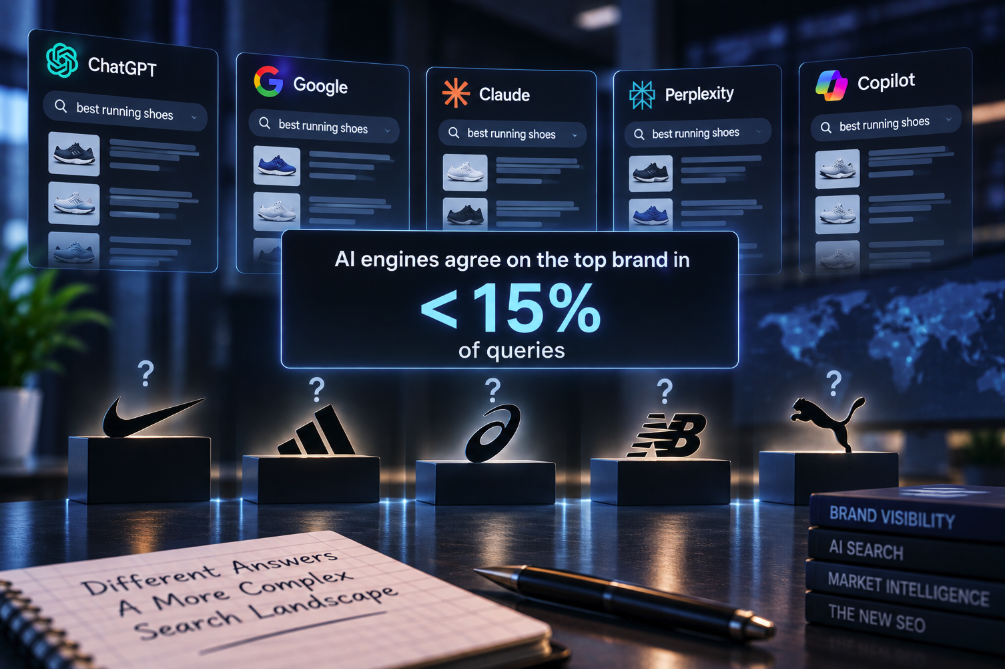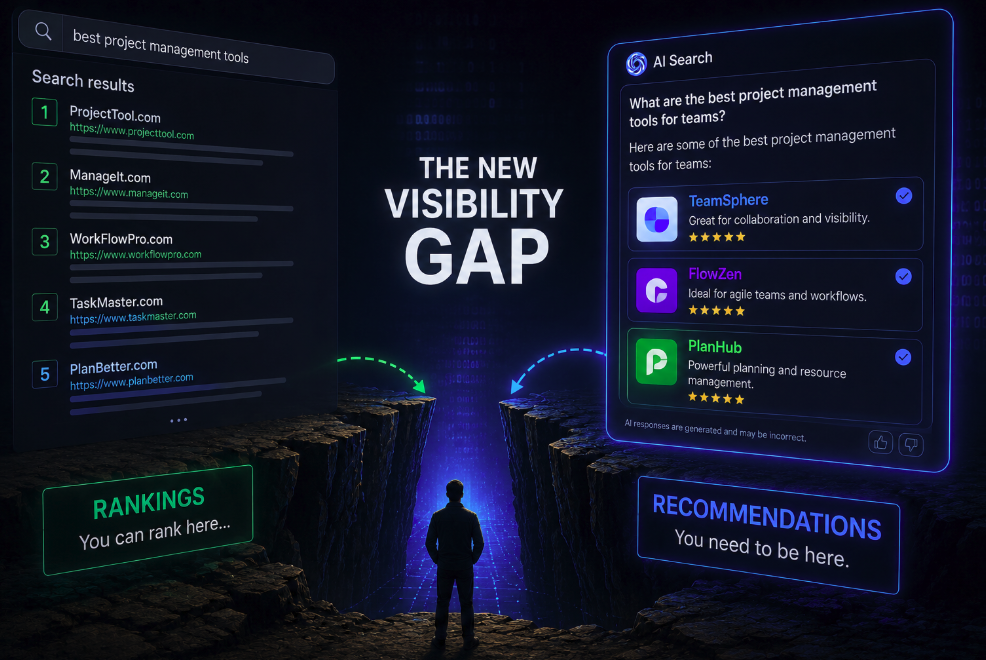
For most of the modern SEO era, visibility could be described through position. A page ranked first, fourth or tenth; marketers could then connect those positions to impressions, clicks and conversions. AI Search is introducing a different competitive mechanism. A brand can perform strongly in conventional organic search and still disappear when a user asks ChatGPT, Gemini, Perplexity or another generative system to recommend a small number of products, companies or services.
A recent NetContentSEO analysis of the emerging gap between rankings and recommendations argues that this difference is becoming measurable. Drawing on 2026 research into organic authority, AI visibility and local recommendations, it identifies a structural change in search: traditional ranking asks whether a brand can be found among a set of results, while AI recommendation asks whether that brand survives the system's much narrower selection process.
AI Search compresses the competitive set
A conventional search engine can expose users to many competing domains. Even a business that does not occupy the first organic position can remain visible across multiple queries, SERP features and stages of a customer journey. Generative systems often compress that landscape into a short answer. When someone asks for the best project management software, insurance provider or running shoe for a particular need, an AI assistant may name only three or four options.
This changes the unit of competition. In traditional SEO, pages compete for relative positions. In an AI recommendation environment, brands may first have to qualify for a consideration set. If a company does not pass that selection stage, there may be no meaningful equivalent of ranking sixth or tenth: the brand simply receives no exposure in that answer.
That does not mean SEO authority has become irrelevant. The research summarized by NetContentSEO indicates that conventional organic strength and AI visibility often correlate. The strategically interesting cases are the exceptions: brands with substantial keyword footprints that appear less frequently in AI answers than their SEO performance would predict, and smaller competitors that repeatedly emerge as default recommendations.
Local discovery exposes the gap particularly clearly
The difference can become even more pronounced in local search. NetContentSEO cites 2026 research based on hundreds of thousands of locations showing a much smaller proportion of businesses appearing in AI recommendations than in Google's local three-pack. The methodologies and platforms are not directly interchangeable, so the figures should not be read as a simple conversion rate from Google visibility to AI visibility. They do, however, illustrate the extreme selectivity of generative recommendation systems.
A local business can be discoverable in conventional search while remaining absent from an AI-generated shortlist. That suggests that ranking signals alone may not explain recommendation visibility. Reviews, sentiment, consistency of business information, third-party references, topical associations and the AI system's confidence in the entity can all become relevant to whether a business is considered safe and useful to recommend.
This is one reason GEO should not be reduced to “SEO for ChatGPT.” Search ranking and generative recommendation overlap, but they are different events with different outputs. A system that has to choose three providers is solving a more selective problem than a search engine displaying ten organic results alongside maps, ads and other features.
Source visibility is not recommendation visibility
The same distinction applies to citations. A publisher's page can be retrieved and cited as evidence without the publisher becoming the company or product being recommended. Conversely, an AI system can recommend a brand because it has encountered consistent third-party evidence about that entity even when the brand's own website is not the dominant organic result.
This means a single “AI visibility” score can hide important differences. Brands should distinguish between retrieval, source citations, entity mentions and recommendations. For commercial queries, recommendation share may be particularly valuable because it measures whether a brand enters the user's consideration set rather than merely supplying information somewhere behind the generated answer.
The distinction fits a broader pattern emerging from AI visibility experiments. Galloni.net previously documented how making NetContentSEO easier to reconstruct as an entity across public, machine-readable information coincided with its appearance in a Meta AI recommendation. That experiment did not establish causation, but it illustrated the right research question: not merely whether a page ranks, but whether an AI system understands an entity well enough to consider and select it.
Recommendation visibility needs repeated measurement
AI recommendations also introduce instability that conventional rank tracking does not fully capture. Generated outputs can vary when a prompt is rephrased, when the same query is repeated, when retrieval results change or when the underlying model is updated. A single successful mention therefore provides weak evidence of durable visibility.
That makes repeated testing essential. A meaningful GEO benchmark should run matched recommendation prompts multiple times and across multiple systems, then measure how often each brand appears. Position within the generated answer, supporting citations and retrieved sources can be tracked separately. The result is closer to a distribution of visibility than a fixed rank.
This approach also prevents marketers from declaring new “AI ranking factors” after a handful of anecdotal prompts. If a brand appears in nine of ten repeated recommendation runs, that is more informative than one screenshot showing it in first place. If another company ranks strongly in Google but repeatedly fails to enter AI shortlists, the mismatch becomes a useful object of investigation.
Rank the market, then ask AI to choose
One practical way to measure the visibility gap is to create matched sets of commercial queries. First, identify the brands dominating conventional organic or local search for a defined intent. Then translate the same intent into natural recommendation prompts and test them across ChatGPT, Gemini, Perplexity and other relevant AI systems.
The analysis should focus on mismatches. Which strong organic performers repeatedly disappear from AI recommendations? Which weaker-ranking competitors are selected disproportionately often? Researchers can then compare the two groups across review profiles, entity consistency, independent editorial coverage, topical associations, structured business information, source diversity and other observable characteristics.
The purpose is not to assume that any one of those characteristics is a ranking factor. It is to build falsifiable hypotheses. If conventional rankings strongly predict AI recommendations after repeated testing, then the visibility gap may be relatively small for that category. If they do not, the unexplained difference becomes the area where GEO research can add value.
AI recommendations may depend more heavily on entity-level confidence
There is a plausible reason recommendation systems could diverge from page rankings. A search engine evaluating a page can ask whether that document satisfies a query. An AI assistant making a recommendation faces an additional problem: whether the underlying entity is sufficiently relevant, credible and appropriate to suggest to the user.
For consequential commercial choices, corroboration may therefore matter. Reviews, editorial articles, comparison sites, forums, databases and other independent sources can collectively reinforce what a brand is known for. A company with one exceptionally optimized landing page may rank well, while a competitor with a stronger and more consistent entity footprint across the wider web may be easier for an AI system to recommend confidently.
This does not invalidate technical SEO, content quality, links or organic authority. Those signals still help information become discoverable and establish the web presence on which AI retrieval can depend. The mistake is assuming that page-level ranking automatically guarantees entity-level selection.
Visibility is shifting from position to selection
The deepest change is conceptual. SEO professionals have spent decades optimizing relative position. AI recommendations introduce a selection gate before position becomes meaningful. First the system decides which entities belong in the answer; only then can marketers debate which brand was mentioned first, described most favorably or supported by the strongest citations.
That distinction becomes economically important as users increasingly allow AI interfaces to perform more of the research process. If an assistant compares alternatives and delivers a concise conclusion without requiring the user to visit ten websites, being present in that conclusion can matter more than occupying a respectable organic position somewhere behind it.
For brands, this creates a second visibility scoreboard. Organic rankings remain essential for understanding performance in conventional search. AI recommendation share measures something different: whether the brand survives the generative system's compression of the market and enters the shortlist presented to the user.
The practical question for GEO is therefore no longer simply “How do we rank in AI Search?” A more useful question is: when an AI system is asked to choose, how often does it choose us? The visibility gap identified by NetContentSEO suggests that answering that question will require new measurement methods, stronger entity-level thinking and a broader understanding of authority than conventional ranking dashboards were designed to provide.