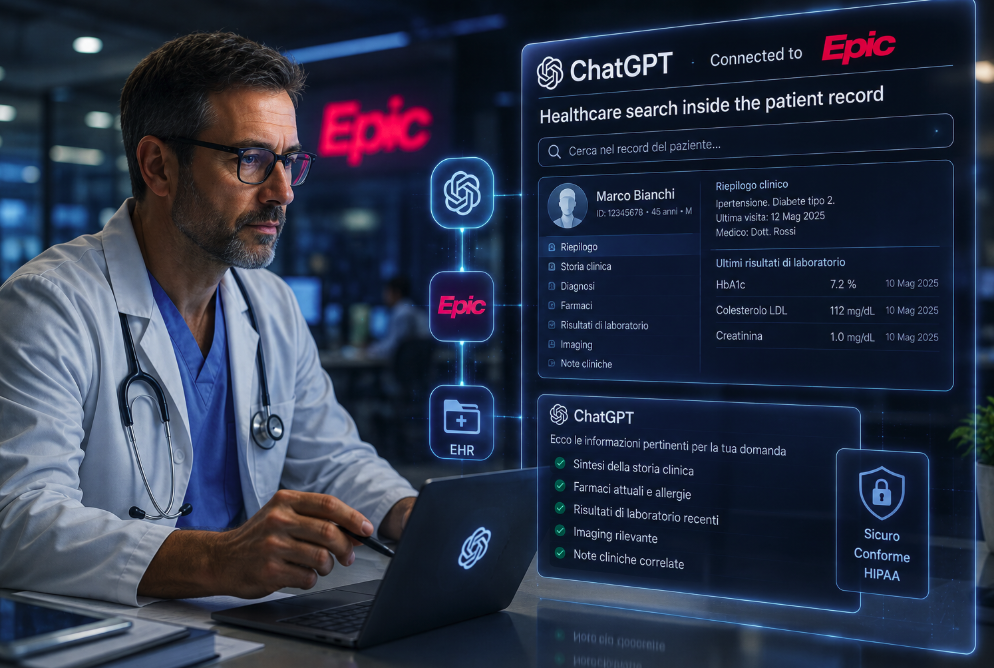
OpenAI is moving ChatGPT deeper into one of healthcare's most important information systems: the electronic health record. On September 1, 2026, the company announced an Epic integration for ChatGPT for Healthcare that allows eligible organizations to bring authorized patient context into ChatGPT and, in supported deployments, place ChatGPT directly inside the EHR workflow. The product story is significant on its own, but it also illustrates a broader shift in AI Search: the answer engine increasingly knows which information environment to search before it evaluates individual documents.
The development was highlighted by NetContentSEO, which frames the launch as a change in retrieval architecture rather than simply another healthcare integration. That interpretation is supported by OpenAI's official announcement. Alongside Epic, OpenAI has introduced a Healthcare Public Data plugin that gives eligible teams structured access to nine official healthcare sources. Together, the two launches show how generative AI can operate across governed data layers rather than beginning every task with the open web.
ChatGPT can now work with authorized Epic patient context
The Epic integration is designed around practical clinical information retrieval. A clinician preparing for an appointment can ask what has changed since a patient's previous visit, which recent laboratory results deserve attention, whether medications have changed, or whether specialist recommendations and follow-ups remain unresolved. ChatGPT can synthesize relevant information from the authorized record and point back to supporting chart information.
OpenAI describes two complementary deployment patterns. In the first, authorized EHR context is brought into ChatGPT for review. In the second, ChatGPT can be integrated into a supported EHR layout so clinicians can use AI-assisted workflows without leaving the patient chart. UCSF Health is participating as a pilot partner and is evaluating whether the integration can reduce the time clinicians spend synthesizing complex records.
The limitations are as important as the capabilities. According to OpenAI's ChatGPT for Healthcare documentation, Epic access is read-only and follows the permissions the clinician already has. An administrator must configure the organization's Epic connection, users authenticate with their own Epic accounts, and access remains subject to existing patient-chart permissions. This is not an autonomous agent that can independently edit a medical record, place orders or override clinical access controls.
Healthcare Public Data creates a second trusted retrieval layer
The Epic connection handles patient-specific context, but healthcare work also depends on research, medication information, clinical trials, coverage rules and provider data. OpenAI's Healthcare Public Data plugin brings nine official sources into ChatGPT and Codex, allowing eligible users to search structured healthcare information without treating the entire public web as the first retrieval layer.
OpenAI's release notes describe the plugin as read-only and separate from patient charts. It can be used to search medical research, clinical trials, medication information, Medicare data and provider records. The company also explicitly warns users not to include protected health information in searches sent to public sources, reinforcing the architectural separation between patient data and public healthcare datasets.
This matters because the appropriate source in healthcare is often determined by the task. If a clinician wants to know what changed in a patient's medication history, the authorized EHR is the logical source. If the question concerns an official drug label, an authoritative medication database is more appropriate than whichever health article happens to rank first on the web. A clinical-trial question similarly benefits from direct access to structured trial data.
AI Search can begin after source selection
Traditional SEO is built around a vast candidate pool. Search engines crawl and index documents, then rank eligible pages against a query. Connected AI systems can operate differently. An organization can explicitly authorize a source environment before the user asks the question, narrowing the retrieval universe through permissions, connectors and system design.
The Epic integration makes this unusually easy to see. A patient's chart does not defeat public medical websites in a ranking competition. It becomes available because the healthcare organization has connected a system of record and the individual clinician has permission to access that patient's information. The source-selection problem has partly been solved before content retrieval begins.
For AI Search and Generative Engine Optimization, this suggests a useful distinction between ranking architecture and access architecture. Open-web publishers compete to be crawled, retrieved, cited and represented. Connected enterprise systems can create another route in which information enters the AI environment through an approved plugin, licensed feed, API or direct database integration. Those pathways may operate under different rules even when the final interface looks like the same conversational assistant.
The GEO lesson is not to optimize medical pages for Epic
It would be easy to turn the announcement into the wrong SEO conclusion: that healthcare publishers should somehow optimize their articles to displace EHR data inside ChatGPT. For many clinical questions, that would be neither realistic nor desirable. Patient-specific information should come from the authorized patient record, while official drug, trial and coverage information may appropriately come from primary structured sources.
The broader GEO lesson is architectural. AI systems increasingly have multiple information layers available to them: the open web, enterprise knowledge, systems of record, licensed datasets, structured databases and specialized connectors. Visibility can therefore depend not only on how well a page communicates an answer, but on whether the source is available within the retrieval layer the system chooses for that task.
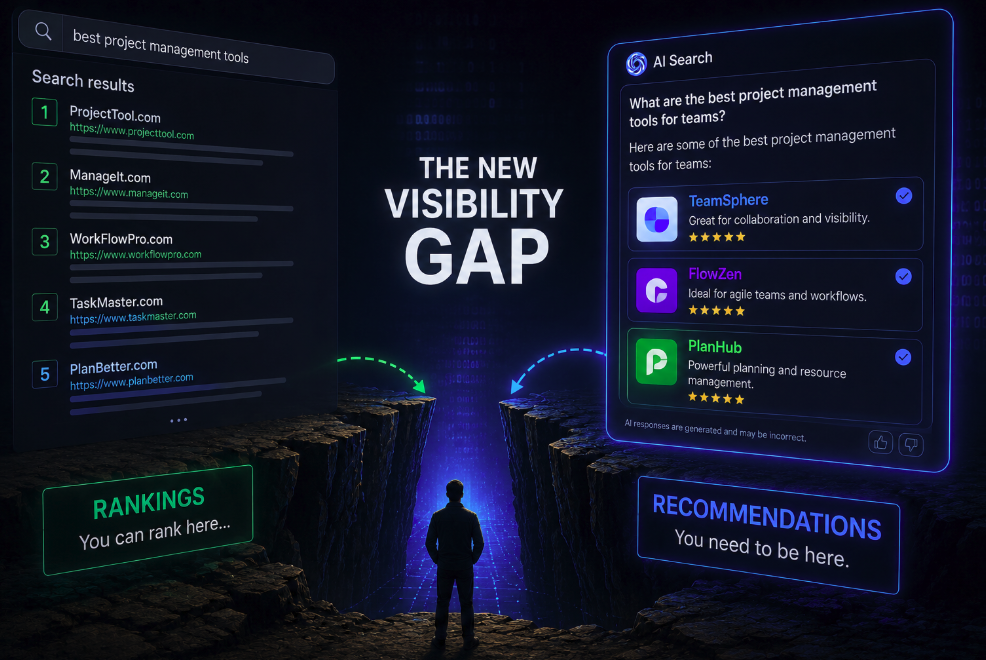
This extends an argument already emerging across AI visibility research. Galloni.net recently examined how AI Search is creating a gap between conventional rankings and recommendations. The healthcare example adds another dimension. Before an AI system chooses which entity to recommend or which document to cite, it may first choose which source environment deserves to be searched.
Connected context makes RAG more operational
The launch is also a practical example of retrieval-augmented generation moving closer to operational systems. RAG is often discussed as a method for grounding an LLM in external information. In enterprise environments, however, the decisive question is not simply whether retrieval exists. It is which repositories are connected, what permissions apply, how provenance is preserved and whether users can verify the evidence behind a generated summary.
Healthcare makes those requirements particularly visible because the cost of using the wrong context can be high. OpenAI says ChatGPT points clinicians back to supporting chart information, allowing them to inspect the underlying record rather than treating the generated synthesis as an independent source of truth. The company's documentation also emphasizes that clinicians remain responsible for reviewing information and making care decisions.
OpenAI has published evaluation results for the connected healthcare workflows. The company says physicians assessed responses across 27 clinical use cases, including pre-visit review, medication review, clinical timelines and handoff summaries. Across 4,363 ratings, OpenAI reports that 99.1% of responses were rated safe. That figure should be read precisely: it is a company-reported safety evaluation, not a claim of 99.1% diagnostic or clinical accuracy, and independent evidence from real-world deployments will remain important.
Search is becoming an interface across systems
The strategic importance of the Epic announcement reaches beyond healthcare. Enterprise AI is increasingly moving away from a model in which users copy information into a chatbot and toward one in which the assistant operates across connected organizational systems. A question may require the AI to decide whether the relevant evidence lives in an EHR, a research database, a company knowledge base, a CRM, cloud storage or the public web.
That changes the meaning of search. The interface can remain a simple conversational box, but the retrieval process behind it becomes a routing problem across multiple governed sources. Entity recognition, permissions, provenance and connector availability can influence the path to an answer before conventional relevance ranking begins.
For publishers and brands, this creates a hierarchy of AI visibility. Being crawlable on the open web remains valuable. Being consistently retrieved and cited is stronger. Becoming an authoritative entity that an AI system deliberately seeks out can be stronger still. In some industries, however, inclusion in a trusted structured dataset or approved enterprise connector may create a fundamentally different route to visibility that traditional SEO metrics cannot capture.
The patient record shows where AI retrieval is heading
Healthcare is an unusually sensitive domain, so it should not be used as a simplistic template for every AI Search product. Patient records require permissions and privacy controls that ordinary web content does not. Official medical datasets also have a level of provenance that many commercial information sources cannot claim. The architecture nevertheless reveals a direction that is relevant far beyond medicine.
Generative AI is becoming an interface over information systems rather than merely another destination on the web. In that environment, the key visibility question may occur before ranking: when the model needs evidence, which source layer does it enter first?
OpenAI's Epic integration makes that question concrete. For a patient-specific task, the answer can now be the authorized health record itself. For public healthcare evidence, ChatGPT can use a predefined collection of official sources. Open-web search remains important, but it is only one layer in a rapidly expanding retrieval ecosystem. GEO will increasingly need to understand not just how information ranks, but how information earns a place inside the architectures AI systems are allowed and designed to search.