The European Union has put a regulatory label on a change that search professionals have been watching for years. On 31 August 2026, the European Commission designated ChatGPT as a Very Large Online Search Engine (VLOSE) under the Digital Services Act, formally placing a conversational generative AI service inside the EU's highest tier of search-engine oversight. The designation is regulatory rather than a declaration that ChatGPT is technically equivalent to Google, but for publishers, brands and SEO teams it is an important milestone: AI-mediated answers are now unambiguously part of Europe's regulated information-discovery landscape.
The Commission said ChatGPT reaches at least 45 million average monthly users in the EU, the threshold relevant to the designation. Reddit and Roblox were designated as Very Large Online Platforms at the same time. According to the Commission's announcement, the newly designated services have four months to comply with additional DSA obligations, including assessing and mitigating systemic risks associated with their services and algorithmic systems. Those risks include the dissemination of illegal content and potential effects on minors, fundamental rights, electoral processes, public security and users' physical and mental well-being.
A regulatory definition with strategic consequences
It would be easy to overstate what happened. The EU did not declare that every chatbot is a search engine, nor did the designation create a new ChatGPT ranking system for publishers to optimize overnight. VLOSE is a legal category under the DSA, and the Commission's decision concerns the scale and role of the designated service within that framework. Nevertheless, the classification is strategically significant because it recognizes that conversational AI can function as information-discovery infrastructure at enormous scale.
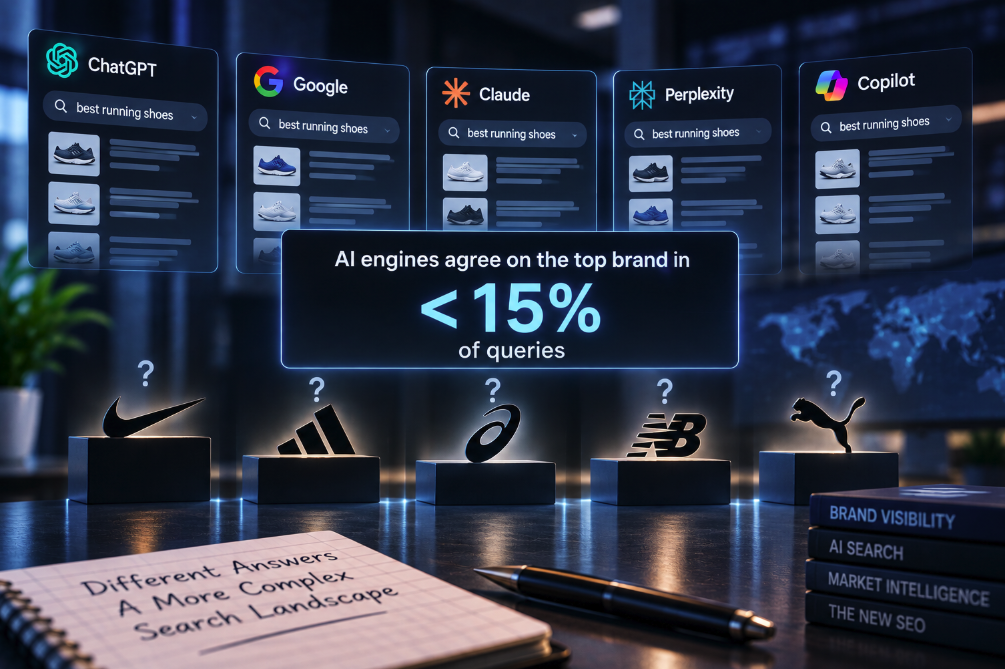
That matters because the user experience of search has already moved beyond ten blue links. A person can ask a question, receive a synthesized answer, request a comparison, refine the criteria and obtain recommendations without ever navigating a conventional search results page. Sources may appear as citations or links, but the central object being consumed is increasingly the generated answer itself. The regulatory vocabulary is now beginning to reflect that behavioral shift.
The development also arrives as the EU's AI regulatory framework becomes more operational. The Commission began enforcing important provisions of the AI Act in August 2026, including new transparency requirements for certain AI systems. The intersection between AI regulation and the DSA therefore deserves attention: large AI services are not operating in a legal vacuum, and the way they generate, surface and contextualize information is becoming a subject of formal oversight.
From rankings to representation
For SEO, the deeper implication is that visibility can no longer be described only by ranking position. In classic search, marketers learned to measure impressions, positions, click-through rates and organic sessions. In AI Search, an additional layer appears between the source and the user: retrieval and generation. A system can find a document, interpret it, extract facts from it and use those facts to construct an answer without reproducing the familiar visibility mechanics of a search results page.
This changes the optimization question. The objective is not simply to rank for a keyword but to make an entity, claim, product or publication understandable enough to be retrieved and represented accurately. Clear authorship, consistent entity information, original evidence, explicit dates, strong topical context and well-supported claims become especially important when an LLM or RAG system has to reconstruct meaning from multiple sources.
That principle is already visible in practical AI visibility experiments. In Galloni.net's experiment on publishing a research repository and testing whether Meta AI could identify NetContentSEO, the central question was whether making an entity easier to reconstruct across consistent, public and machine-readable sources could improve recognition by an AI system. The EU's VLOSE designation does not prove any particular GEO technique works, but it strengthens the strategic reason to study retrieval, entity recognition, citations and answer inclusion as first-class visibility metrics.
What publishers and brands should measure now
The immediate response should not be a rush to invent a mysterious set of “ChatGPT ranking factors.” The more useful approach is measurement. Brands can establish repeatable prompts around their products, categories and areas of expertise, then track whether they appear in relevant answers, how they are described, which competitors are recommended and what sources are cited. Those observations should be repeated over time because AI answers can change with model updates, retrieval results, query wording and fresh web information.
Publishers should also distinguish between being known to a model and being selected as a source for a particular answer. Those are different problems. Entity recognition concerns whether the system can reliably understand who or what an organization is; retrieval concerns whether relevant material can be found at query time; source selection concerns whether the system considers that material useful enough to support the response. GEO and AI Search analysis become more rigorous when those layers are measured separately rather than compressed into a single visibility score.
Traditional SEO remains part of this system rather than becoming obsolete. AI products frequently depend on accessible web documents, search indexes and high-quality sources. Crawlability, information architecture, structured data, internal linking and authority still matter, but they now feed a broader discovery environment in which the final interface may be a generated answer rather than a ranked page of links.
Transparency will become a central AI Search issue
The DSA designation also raises questions that extend beyond marketing. When a major AI service synthesizes information, users need meaningful ways to understand how reliable that information is and, where appropriate, where it came from. For publishers, attribution affects trust, traffic and the economics of producing original material. For regulators, the stakes can include systemic risks involving elections, public safety, minors and fundamental rights.
This is where the VLOSE designation could become particularly consequential. The DSA imposes enhanced accountability and risk-management duties on services of this scale. Applying those principles to generative search is inherently more complex than examining a static list of ranked documents, because an AI answer is constructed dynamically and may combine retrieval, model knowledge, contextual interpretation and multiple sources into one response.
AI Search is no longer a side channel
The NetContentSEO analysis that highlighted the designation captures the larger shift correctly: AI visibility is moving from an experimental concern to a mainstream search issue. The most important nuance is that “search engine” here is a formal DSA classification, not evidence that conversational AI and traditional web search have become technically identical.
For digital publishers and search professionals, however, the practical direction is unmistakable. Discovery increasingly happens through systems that retrieve, summarize, compare and recommend rather than merely rank documents. Success therefore depends not only on whether a page can be found, but on whether its information can be understood, trusted, selected and represented accurately by AI systems.
The European Commission's decision gives that transition regulatory weight. AI Search is no longer simply a prediction about the future of the web. In Europe, one of its largest services is now formally regulated as a very large online search engine, and the search industry should treat the implications for visibility, attribution and accountability with the same seriousness it once reserved for changes to the traditional SERP.