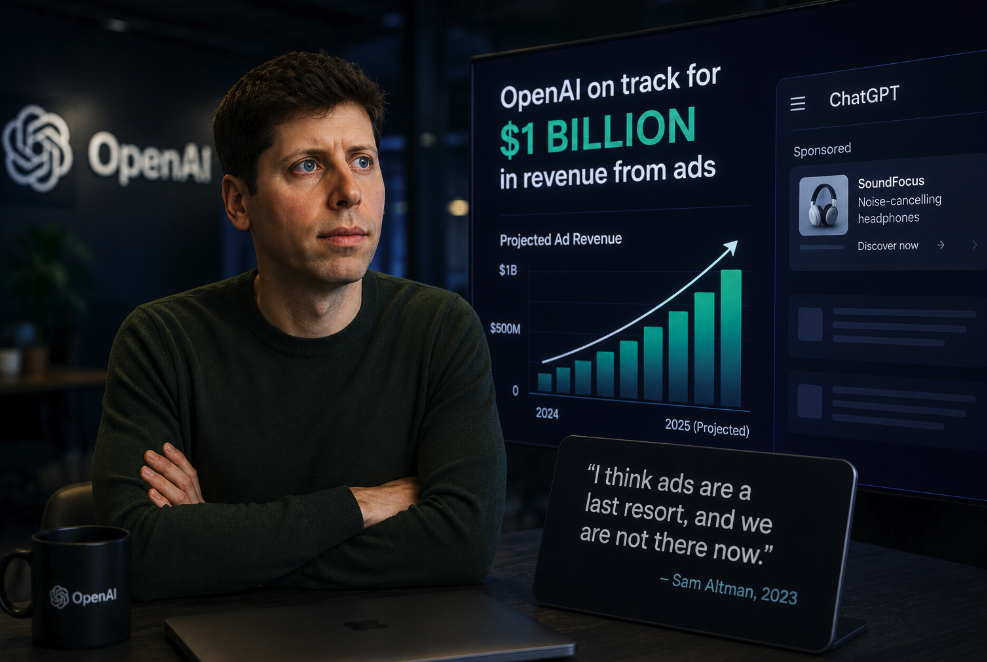
OpenAI's advertising business has moved from experiment to billion-dollar business at remarkable speed. On 31 August 2026, the company announced that ChatGPT Ads had reached a $1 billion annualized revenue run rate less than 200 days after launch, with tens of thousands of advertisers now using the platform. The milestone gives fresh context to a striking reversal in the public narrative around OpenAI and advertising: a monetization model that once appeared secondary is rapidly becoming a significant pillar of the company's commercial strategy.
The figure, highlighted by MarketWatch, is now confirmed directly by OpenAI's own announcement. The company says advertising sits alongside subscriptions, enterprise products and usage-based APIs in a diversified business model. More importantly for marketers, OpenAI is no longer treating ads as a narrowly controlled U.S. pilot: self-service access through Ads Manager is expanding across India, Europe, the Middle East and North Africa.
From cautious experiment to advertising platform
The pace of development is notable. OpenAI began testing ads in ChatGPT in the United States in February 2026 for logged-in adults using the Free and Go tiers. At launch, the company framed advertising as a way to support broader access to increasingly capable AI while protecting the characteristics that make a conversational assistant useful. It said ads would remain separate from answers, would not influence ChatGPT's responses and would not give advertisers access to users' private conversations.
Six months later, the infrastructure looks much more like a mature performance-marketing platform. OpenAI says CPC and outcome-optimized bidding now account for the majority of campaigns, while its Pixel and Conversions API provide measurement foundations. Product feeds, geographic targeting and custom audiences have also been added. The company says one ecommerce advertiser generated a threefold return on ad spend over 28 days, while a technology partner reported that more than 80% of ad-driven ChatGPT traffic consisted of new customers.
The expansion into Europe has been especially significant. OpenAI announced in August that ChatGPT Ads would reach 31 European markets, including Italy, Germany, France, Spain, Sweden, Norway, Denmark, the Netherlands and Austria. The company now says advertisers outside the United States account for a growing share of revenue and that many large clients are running campaigns across multiple markets.
Why ChatGPT is an unusual advertising environment
The commercial opportunity is not simply another place to display banners. Search advertising became extraordinarily valuable because search queries reveal intent. A user searching for a mortgage, running shoes or accounting software is often much closer to a decision than a user passively consuming entertainment. Conversational AI potentially adds another layer because people can explain their objective, constraints, preferences and trade-offs in much richer language than a traditional keyword query.
OpenAI's advertiser materials explicitly position ChatGPT around these decision-making moments: exploring options, comparing alternatives and deciding what to do next. That makes the emerging format particularly relevant to performance marketers. Instead of targeting only a keyword or broad audience segment, an AI-native advertising system can potentially understand the context of an active task while keeping the commercial placement distinct from the assistant's answer.
This separation is critical. OpenAI's current policy is that ads are clearly labeled and appear separately from ChatGPT responses. The company also says advertising does not affect the answers ChatGPT provides. For users, maintaining that boundary is a trust issue; for marketers, it means paid visibility and organic AI visibility remain different disciplines even when they occur within the same conversational interface.
Paid AI visibility and GEO are not the same thing
The rise of ChatGPT Ads makes an important distinction more urgent for SEO and Generative Engine Optimization teams. A sponsored placement can buy exposure, but it does not mean the advertiser has been selected as a source, recognized as an authoritative entity or recommended organically by the model. Conversely, a company can appear in an AI-generated comparison or citation without purchasing advertising.
That creates a search ecosystem with at least two parallel visibility markets. The paid layer includes campaign targeting, bidding, creative, measurement and conversion optimization. The organic layer includes retrieval, entity recognition, source selection, citations and the representation of brands or products inside generated answers. Strong AI Search strategy will need to understand both without confusing one for the other.
The distinction matters even more as ChatGPT's role in information discovery becomes formalized. Galloni.net recently examined the EU's designation of ChatGPT as a Very Large Online Search Engine, a regulatory development that underscores how conversational AI has become part of the search landscape. Advertising adds a second economic dimension to that transition: ChatGPT is not only becoming a place where users search and make decisions, but also a place where companies can pay to participate in those decision journeys.
The trust constraint may define the market
Advertising inside a conversational assistant carries risks that are different from those of a conventional search results page. Users may discuss sensitive personal situations, financial concerns, health questions or emotionally vulnerable topics in a conversational interface. An advertisement inserted into the wrong context could feel far more intrusive than a sponsored search result beside a transactional keyword.
OpenAI's current ad policies therefore exclude placements around sensitive and brand-unsafe contexts and place restrictions on regulated or high-risk categories. The company also says users can control ad personalization and that Plus, Pro and business-oriented paid plans remain ad-free. These safeguards are not peripheral product details. They are likely to determine whether conversational advertising can scale without weakening the trust on which an AI assistant depends.
That trade-off helps explain why advertising was historically treated cautiously in discussions about AI assistants. A recommendation from an assistant can carry a different psychological weight from an ordinary display ad. If users begin to suspect that commercial payments affect the substance of answers, the usefulness of the system could be undermined. OpenAI's insistence on separating ads from answers is therefore both a product principle and an economic requirement for sustaining the advertising business itself.
A new competitor to Google and Meta — but not yet at their scale
A $1 billion annualized run rate is significant for a product launched only months ago, but it remains small relative to the global advertising businesses built by Google and Meta. The more important signal is the growth trajectory and the nature of the inventory. ChatGPT has more than one billion weekly active users, according to OpenAI, and many of those interactions occur precisely when people are researching, evaluating and deciding.
That creates a potentially valuable category of intent-driven inventory that did not exist at comparable scale before generative AI. If users increasingly begin product research inside conversational systems rather than conventional search engines, advertising budgets are likely to follow attention and measurable outcomes. OpenAI's rapid development of bidding, conversion tracking, product feeds and self-service campaign management suggests it is building for that possibility rather than treating advertising as a temporary subsidy.
The competitive implications extend beyond ad budgets. Search advertising historically gave Google a powerful economic incentive to improve its ability to understand commercial intent. Conversational advertising could create a similar feedback loop around AI-assisted decision making, where better understanding of user goals makes ads more relevant and relevant ads make the free product more economically sustainable.
What marketers should watch next
The next phase will be defined less by the billion-dollar headline than by how the platform performs as it scales. Marketers should watch conversion quality, incremental customer acquisition, attribution, ad pricing and the relationship between conversational context and campaign performance. They should also pay attention to new formats: OpenAI says it plans to introduce additional objectives, buying options and more native ways for businesses to interact with consumers inside ChatGPT.
For SEO and GEO teams, another question will be whether AI advertising changes user behavior around organic citations and recommendations. Even with strict separation between ads and answers, a conversational results environment has limited attention. Understanding how sponsored placements coexist with generated recommendations will become increasingly important as brands compete for both paid and organic visibility in the same interface.
The broader strategic lesson is already visible. AI Search is developing the commercial infrastructure that transformed traditional web search from a navigation technology into one of the world's largest advertising markets. OpenAI's first billion-dollar annualized milestone does not mean that ChatGPT will replicate Google's model, and the company continues to emphasize a diversified revenue strategy. It does show, however, that conversational intent has substantial economic value.
For marketers, the era of AI visibility now has two clearly defined fronts. Brands need to earn inclusion in generated answers through authority, relevance and retrievable information, while also learning how to buy attention responsibly when users are actively making decisions. ChatGPT Ads reaching a $1 billion run rate in under 200 days is a strong indication that the second market is arriving much faster than many expected.