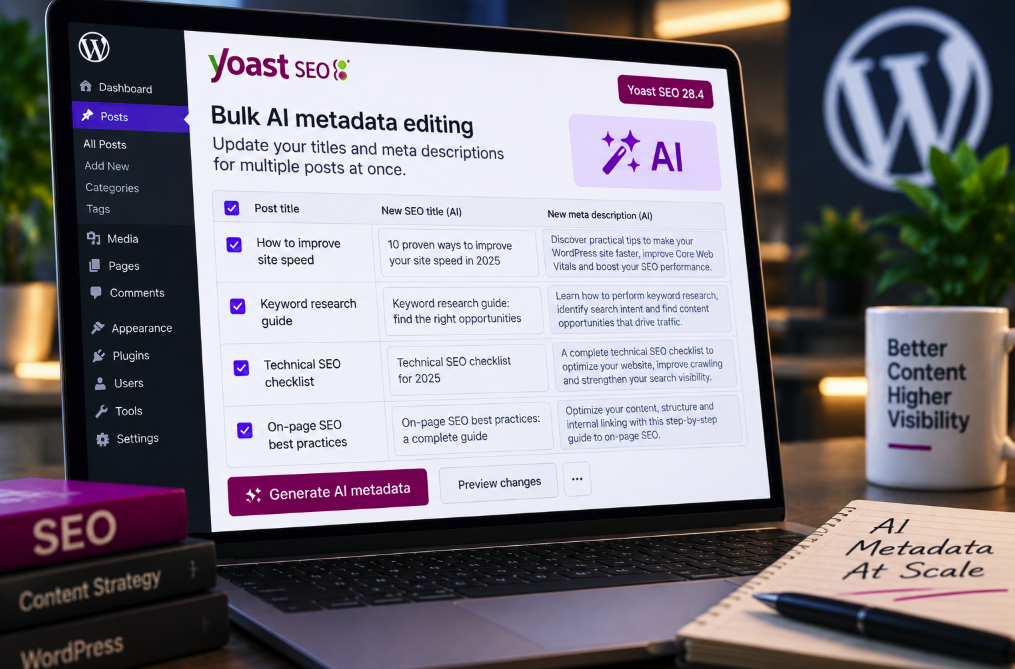
Generative AI has made writing SEO titles and meta descriptions dramatically faster, but speed is no longer the hardest problem. For publishers, agencies and ecommerce teams managing hundreds or thousands of URLs, the difficult questions are operational: which pages actually need new metadata, which AI suggestions deserve extra scrutiny and how can editors review large batches without turning approval into a rubber stamp?
Yoast SEO 28.4, released on September 1, focuses directly on that workflow. As NetContentSEO's analysis of the release notes, the update should not be confused with the original introduction of bulk AI metadata generation. Yoast had already added AI-assisted metadata drafting to its redesigned Bulk Editor earlier in 2026. Version 28.4 instead improves the layer around generation: finding weak fields, selecting them efficiently, identifying risky AI drafts and moving into bulk optimization from the WordPress content screens where editors already work.
Yoast is turning the Bulk Editor into an SEO audit queue
The most useful change may be one of the least glamorous. According to Yoast's official 28.4 release announcement, the Bulk Editor now includes “needs improvement” filters for SEO titles, meta descriptions, social titles and social descriptions. Instead of scanning an entire content library, an editor can isolate fields that are empty or receive a weak score under the same evaluation logic used in the individual post editor.
This matters because metadata debt is rarely distributed evenly across a site. Some pages may have missing descriptions, others may contain outdated messaging, and many may already be perfectly adequate. A site-wide regeneration project risks spending AI credits and human review time on content that did not need intervention in the first place.
Quality-based filtering changes the workflow from “generate everything” to “find the problem set first.” Matching options in the Select menu then allow users to select the affected posts on the current page according to the same quality criteria. Yoast has also added Shift+click range selection, a small interface improvement that becomes valuable when editors are repeatedly assembling custom batches.
Version 28.4 is about control, not the arrival of bulk AI
The distinction between the underlying AI feature and the new release is important. Yoast's Premium changelog shows that version 28.1, released in July, introduced bulk AI-powered metadata suggestions. That earlier release allowed users to draft SEO titles, meta descriptions and social sharing metadata for multiple posts from the Bulk Editor while retaining the ability to review suggestions before saving them.
Yoast 28.4 builds on that capability rather than replacing it. The official Yoast SEO changelog lists direct Bulk Editor access from the Posts and Pages bulk-actions menus as the headline enhancement and documents a related bug fix affecting the AI generator's thin-content warning. The broader release article describes the additional quality filters, selection improvements and safeguards that make the existing bulk-generation workflow more practical at scale.
This is a more mature direction for AI-assisted SEO tools. Once generating 50 descriptions becomes technically easy, generation itself stops being the differentiator. The useful product becomes the system that decides where automation should be applied and helps humans identify where it is most likely to fail.
Thin content now triggers an AI quality warning
The most consequential safeguard in the update concerns the source material used for generation. Yoast's AI metadata features derive suggestions from the content already written on the page. When that content is sparse, the model has less evidence from which to produce an accurate title or description.
Previously, Yoast says posts with very little written content could still receive generated suggestions without clearly signaling that the input was unusually thin. After a bulk generation run, the editor can now flag the posts whose AI suggestions were created from limited content. The editor can then inspect those cases more carefully, strengthen the underlying page and regenerate where appropriate.
The logic addresses a familiar problem in generative AI: fluency can hide uncertainty. A polished meta description can sound authoritative even when the page does not contain enough information to justify every claim or emphasis. At scale, those plausible-sounding errors become difficult to notice because reviewers are processing many similar outputs in succession.
Yoast's safeguard does not attempt to guarantee that every generated description is accurate. Instead, it identifies a condition under which the suggestion deserves more skepticism. That is a sensible quality-control pattern for AI systems: expose weak inputs rather than pretending that fluent output means strong evidence.
The changelog reveals an important technical detail
Yoast 28.4 also fixes a bug related to how the plugin determined whether a page contained enough material for AI generation. The official changelog says the prompt to write more content could fail to appear when a post consisted largely of block markup because that markup was counted as content.
That is a small implementation detail with a broader lesson. AI features embedded in content-management systems do not operate on an abstract idea of “the article.” They receive a representation of the page that may include structural markup, blocks, metadata and other machine-oriented information. If the system incorrectly treats markup volume as semantic substance, it can overestimate the amount of evidence available to the model.
Correctly separating meaningful content from its structural wrapper is therefore part of AI quality control. The better the CMS understands what information is actually available, the better it can warn users when generation is being attempted from an inadequate source.
Bulk editing now starts where WordPress editors already are
Version 28.4 also reduces friction between routine content management and SEO maintenance. Users can select posts or pages from their normal WordPress overview, choose Yoast's Bulk edit action and carry that selection into the Bulk Editor. Editors no longer need to notice a group of problematic articles, remember their identities and then reconstruct the selection inside a separate SEO tools screen.
Yoast's current Bulk Editor documentation says the tool can manage SEO titles, meta descriptions, social titles and social descriptions from one interface. It can also work with supported custom post types, which can include WooCommerce products and other content types added by plugins. AI generation is available with eligible paid plans.
This tighter connection to WordPress matters because SEO work often begins during ordinary editorial activity. A team may be reviewing older posts, preparing a content refresh or checking a product category when it notices inconsistent metadata. Bringing the selected items directly into the optimization workspace makes bulk SEO feel like an extension of content operations rather than a separate maintenance project.
AI metadata still requires a human publishing decision
Yoast's AI Generate documentation is explicit that generated metadata remains editable and subject to user approval. The system drafts suggestions; the editor decides whether to apply, dismiss or modify them. That checkpoint becomes increasingly important as batch size grows.
Reviewing one AI-generated title is straightforward. Reviewing 200 can create automation bias: once most suggestions look acceptable, editors may stop examining them with the same attention. Repetition, unsupported claims, inconsistent capitalization, stale product details and subtle changes in brand voice can slip through even when individual outputs appear professionally written.
The productivity calculation therefore cannot be based only on generation time. A useful bulk workflow must reduce both drafting effort and review cost without sacrificing accuracy. Filters that identify weak existing metadata and warnings that identify weak source content help concentrate human attention on the cases where it is most valuable.
Metadata automation should start with prioritization
For large sites, the most efficient use of AI is rarely to regenerate everything. A better process starts by segmenting the content library. Missing or poor titles can form one queue, weak descriptions another, outdated social metadata another. High-value pages can receive stricter manual review, while low-risk changes can be processed in larger batches.
That approach also protects metadata that already performs well. An existing title may have accumulated strong click-through behavior or may express a product's positioning precisely. Replacing it merely because AI can generate an alternative introduces change without a demonstrated problem. Automation should reduce SEO debt, not create unnecessary volatility.
The same principle applies to thin pages. If the underlying content is inadequate, generating a better snippet can become cosmetic optimization. A compelling description may increase expectations that the page itself cannot satisfy. Yoast's new warning implicitly pushes the workflow upstream: improve the content first when necessary, then ask AI to summarize it.
The next phase of AI SEO tools is governance
Yoast 28.4 reflects a broader change in the SEO software market. Early generative features were often judged by whether they could produce a title, description or paragraph. That capability is rapidly becoming ordinary. The harder product problem is governance: deciding what should be generated, controlling access, surfacing uncertainty, preserving editorial standards and making review efficient enough to survive at scale.
That is especially relevant as CMS platforms become increasingly connected to AI services. Yoast says it is also gradually rolling out a MyYoast connection option for sites its AI service cannot normally reach, including installations behind firewalls, offline environments or configurations where the REST API is disabled. Instead of leaving users at a dead end, the product can offer an alternative connection path when available.
The feature is another reminder that AI inside WordPress is not simply a text-generation button. It depends on site access, authentication, remote services, content extraction, permissions and review workflows. As those systems mature, reliability and control become as important as the model producing the text.
Yoast 28.4 makes AI less indiscriminate
The most interesting aspect of Yoast SEO 28.4 is therefore not that it can generate metadata at scale. That capability already existed. The release is valuable because it makes bulk generation more selective and more inspectable.
Editors can identify metadata that actually needs attention, assemble batches faster and see when generated suggestions were built from weak source material. The final publishing decision remains human. For agencies, publishers and ecommerce teams managing large WordPress estates, that combination is more useful than another promise of one-click automation.
Generative AI makes producing SEO copy cheap. Judgment remains expensive. Yoast's latest Bulk Editor improvements are an acknowledgment that the winning workflow is not the one that generates the most metadata; it is the one that helps a team spend human attention on the right pages and the highest-risk suggestions.