Keyword research normally begins with an assumption. An SEO specialist enters a phrase, a product name or a topic into a research tool and asks what people search for around it. Google Trends has now introduced a small but important change to that sequence: users can start with a category instead of a keyword and discover what people are searching for inside that part of the market.
The update was examined in a NetContentSEO analysis published September 3 after Google announced category filters for the redesigned Trends Explore experience. As Barry Schwartz reported at Search Engine Roundtable, the filter works both with an existing query and without one. Google's own recommendation is particularly interesting for researchers: apply a category without entering a query to see category-specific top searches across selected regions and timeframes.
Google Trends can now begin one level above the keyword
The difference is more significant than the interface change suggests. Conventional keyword discovery is seed-driven. A marketer decides that “running shoes,” “CRM software” or “electric cars” is worth investigating, enters that phrase and then expands outward through related queries, suggestions and keyword databases. The research universe is shaped by the initial language supplied by the analyst.
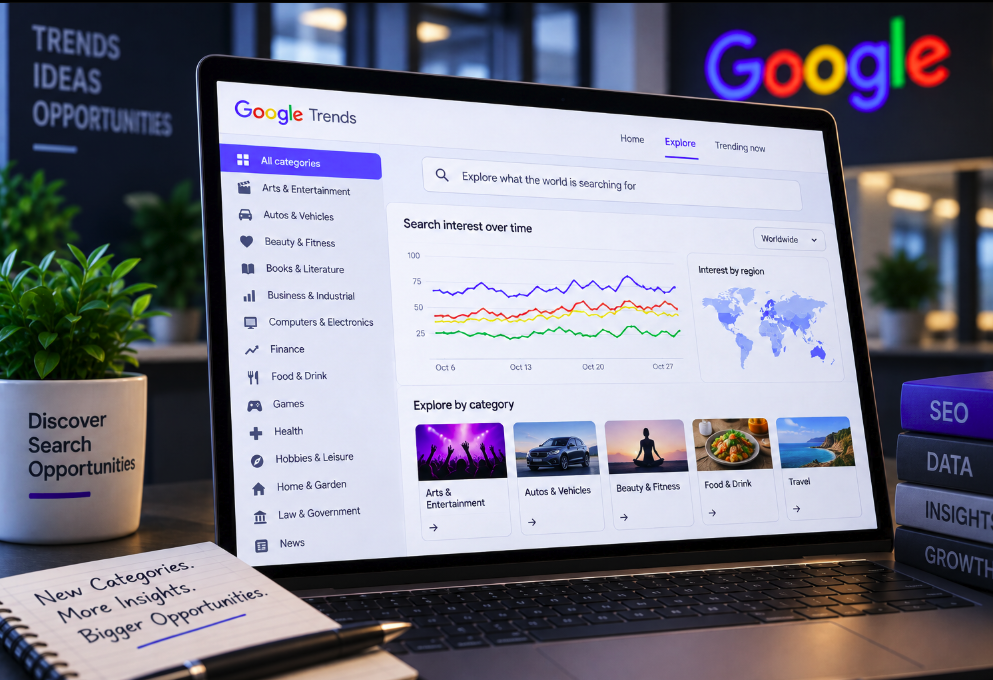
Category-first exploration reverses part of that process. A researcher can choose a broader Google category such as Books & Literature, Beauty & Fitness or another relevant vertical, set a geography and timeframe, and examine the searches emerging inside that market. The starting question changes from “how is this keyword performing?” to “what are people searching for in this category?”
That makes Google Trends more useful before a keyword list exists. A business can begin with the market it understands and allow search behavior to reveal some of the vocabulary, subjects and events that deserve closer investigation.
The category filter also helps separate ambiguous meanings
The same feature can improve research when a word has several meanings. “Java” is the example used in coverage of the update. Without context, the term can refer to the programming language, the Indonesian island, coffee and other concepts. A trend line combining those interests can be misleading if the researcher is studying only software.
Applying a relevant category narrows the context around the query. It does not make Google's classification infallible, and analysts should still inspect related searches and topics, but it provides an additional way to reduce obvious semantic noise before drawing conclusions from the data.
This is especially useful for brands whose products share names with places, people or generic concepts. A traffic spike can otherwise look like increased commercial demand when it is actually being driven by an unrelated news event or cultural trend.
Discovery becomes less dependent on the marketer's vocabulary
One of the persistent weaknesses in keyword research is that marketers tend to search using the language they already know. Product teams have internal terminology, industries develop jargon and brands become accustomed to describing problems in particular ways. Customers may use entirely different words.
Starting with a category can reduce that bias. Instead of translating an internal vocabulary into a list of presumed search terms, a team can observe which queries are attracting attention within the category and then investigate why. Emerging terminology can surface before it has been incorporated into the company's taxonomy or editorial calendar.
For content strategy, that makes the feature useful as an early discovery layer. A publisher can identify themes that appear to be accelerating, then move into conventional keyword tools, Search Console data and SERP analysis to determine whether the opportunity is relevant and substantial enough to justify new content.
Google Trends remains a relative-interest tool
The expanded discovery capability does not change the most important limitation of Google Trends: its Explore data is normalized. A value of 100 represents peak relative popularity within the selected context; it does not mean that a term received 100 searches, nor does it reveal absolute monthly search volume.
Google's current Trends Help documentation confirms that the Explore page supports query comparison, regional analysis, related searches and category refinement. Separately, Google's documentation for Trending Now explains that its trend data and filters are designed around changes in search interest rather than functioning as a conventional keyword-volume database.
This distinction is crucial when category discovery surfaces a dramatic trend. A term can rise sharply from a very small baseline. Another query with enormous and stable demand may appear less exciting because its relative interest is not changing as quickly. Trends is excellent for direction, acceleration, seasonality and geographic variation; it should not be treated as a standalone traffic forecast.
A stronger workflow combines discovery with validation
For SEO teams, the practical workflow is therefore sequential. Category-level Trends data can identify a subject worth investigating. Related searches can reveal the language around it. A conventional keyword platform can estimate demand and competitive difficulty. Search Console can show whether the existing site already has impressions around the topic. SERP analysis can clarify intent and the types of pages Google currently rewards.
Business data then determines whether the opportunity matters. A topic with fast-growing search interest may still have little connection to the company's products, audience or expertise. Another trend may be strategically important even with modest search volume because it signals changing customer needs or a new commercial category.
The value of Google's update is not that it replaces those steps. It gives the research process a better way to generate hypotheses before those validation tools are used.
International SEO can start with local demand rather than translation
Category discovery is particularly promising for international search research because Google allows the Explore experience to be narrowed by region and timeframe. Search behavior rarely develops identically across markets. A product format may surge in one country while remaining obscure in another, and the terminology used to describe the same need can differ substantially between languages and cultures.
A translation-first workflow can hide those differences. An SEO team takes a successful English keyword, translates it and then checks whether the translated phrase has demand. Category-first discovery creates another option: begin with the relevant market and category, observe what local users are actually searching for and then build the keyword universe from those signals.
This does not eliminate the need for native-language expertise. On the contrary, interpreting why a term is trending requires cultural and commercial context. But it can help teams avoid assuming that the vocabulary of one market is the natural starting point for another.
The update strengthens the connection between SEO and market research
Google Trends has always sat somewhere between keyword research and audience research. It measures search behavior, but its strongest use cases often involve questions larger than the optimization of a single page: whether consumer interest is changing, whether demand is seasonal, where a topic is strongest geographically or whether an event has altered the language people use.
Category-level discovery pushes the tool further in that direction. Product teams can use it to spot emerging concerns inside a market. Editorial teams can use it to identify themes before assigning stories. Paid media teams can monitor shifts in demand. SEO teams can use the same observations to decide which keyword sets deserve deeper analysis.
This matters as search itself becomes more fragmented. Users now discover information through conventional Google results, AI Overviews, AI Mode, social platforms and conversational assistants. The underlying language of demand remains valuable even when the final discovery interface changes. Understanding what subjects people are beginning to investigate can inform both traditional SEO and broader AI Search strategies.
Galloni.net has previously argued that visibility is increasingly moving from simply being found toward being selected by generative systems. Category-level Trends research operates earlier in that chain. Before optimizing for ranking or selection, a team first needs to understand which subjects are entering the audience's consideration set at all.
Category discovery should not become automated trend chasing
The obvious risk is that easier discovery encourages publishers to chase whatever happens to be rising. A top search inside a category is not automatically an editorial opportunity. The interest may be driven by breaking news, entertainment, controversy or a temporary event with no meaningful connection to the business.
Before turning a trend into content, teams should inspect the underlying searches, current results and likely intent. They should also ask whether they can contribute genuine expertise and whether the topic is likely to remain relevant long enough to justify the investment. Longer timeframes can help distinguish a sustained shift from a short-lived spike.
This is where human judgment remains essential. Google Trends can reveal a change in attention; it cannot decide whether that attention belongs in a company's strategy.
Google Trends is becoming a discovery engine for search demand
The category filter is a modest product update with a useful methodological consequence. Researchers no longer need to know the first keyword before Google Trends can help them explore a market. A category, geography and timeframe can become the starting point, with individual queries emerging from the data rather than being imposed on it.
For SEO, that creates a cleaner bridge between market observation and keyword analysis. Teams can identify where attention is moving, discover the vocabulary users are adopting and then validate the opportunities with more precise search and business data.
Google Trends still does not provide absolute keyword volume, conversion potential or a guaranteed content strategy. What it can now do more effectively is answer an earlier question: before we decide which keyword to optimize, what is this market actually becoming interested in?